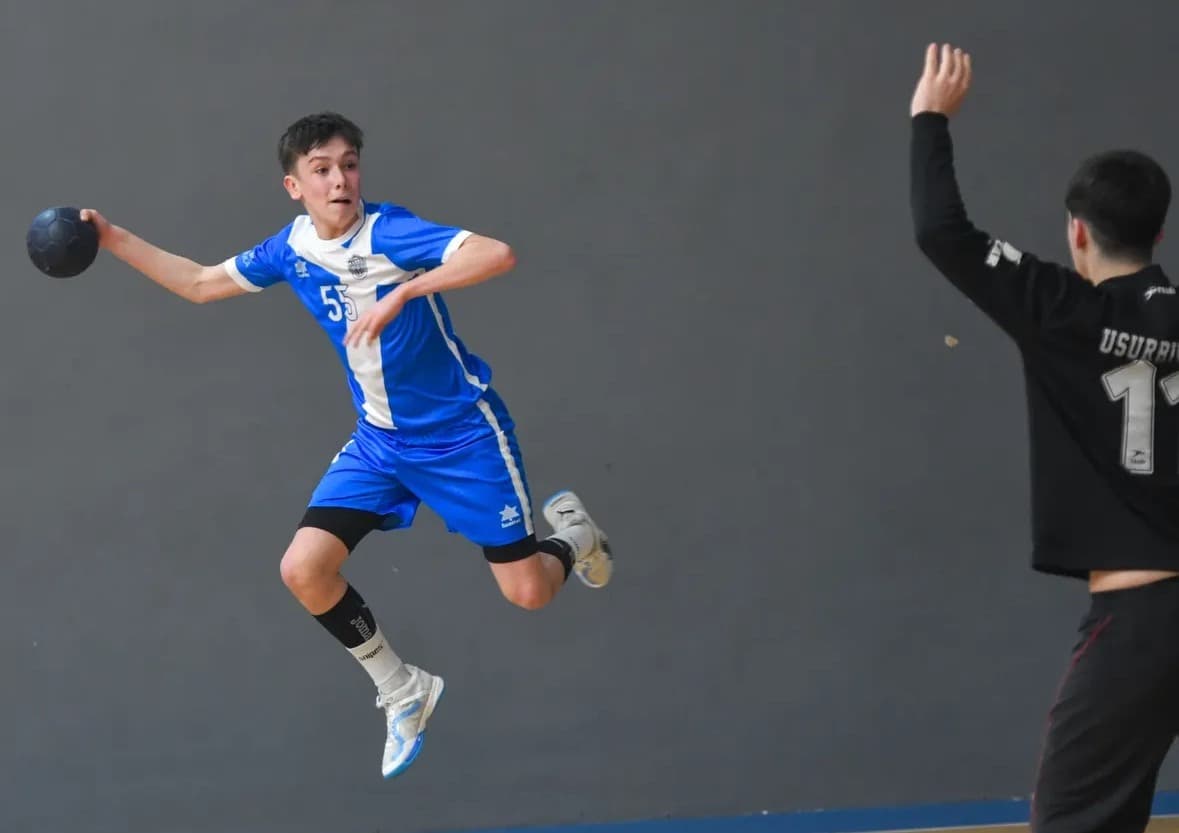

When elite handball moved from the six-defender line system to open defences and high-pressure systems (something I analysed in detail in the article on la crisis del 6:0 en la élite, the wing's function changed too. Not gently or progressively. Radically.
The wing of classical handball was a specialist. He had to run fast, receive on the move and shoot from impossible angles. He was dangerous, yes. But he was peripheral to the collective playing system: he depended on the centre back finding him, he depended on the opposing defence making the mistake of letting him run free.
The wing of modern handball is something else. He is the engine of the counterattack, the first link in the offensive transition, the player who turns the goalkeeper's saves into goals before the opposing defence has time to organise. Djibril M'Bengue, Dika Mem, Ferran Solé, Siarhei Shylovich. Different names, different profiles, but all with one constant: their speed in reading the situation and their ability to turn numerical superiority in transition into a goal.
The fast break as a system, not as a circumstance
The most common mistake I see in lower-category teams when they try to imitate elite handball in transition is treating it as a circumstance. "If there's a fast break, we run." That approach is always late.
In the best teams in the world, the fast break is not a reaction to what happens. It is an anticipatory system. The runners (normally the two wings, sometimes a back or a centre back depending on the system) start moving towards the opposing goal before their goalkeeper has the ball. Not when the goalkeeper saves, but when the shooter starts the shooting movement. They are betting on the save. And when the save comes, they are already three steps ahead of the opposing defenders, who are still processing what has just happened.
This anticipation is trained, it is not instinctive. In my training sessions in Trapagaran, we have specific early-start exercises: the wings learn to read the signals of the opposing shooter (the angle of the body, the position of the arm) to identify whether the shot is going to be saved or not. It is not information that can be calculated consciously in real time. But it can be developed as an automatic pattern with repetition and constant feedback.
The three-option decision in under a second
When a wing receives the goalkeeper's pass on a fast break and carries the ball alone or with a teammate towards goal, he has to make a decision in under a second: do I shoot?, do I pass to the most advanced teammate?, do I wait for support to turn a 2 against 1 superiority into a more comfortable situation?
This decision seems simple when described like that. In the match, with adrenaline, accumulated fatigue and a defender approaching at 25 km/h, it is the hardest decision a handball player makes. And the way a wing makes it (how fast, with what criterion, with what consequence) largely determines how many goals his team scores in transition over a season.
The criterion that works: the wing only shoots if he has more than a 70% probability of success in the situation he perceives. If not, he looks for the pass. The problem is that this probability is not a mathematical calculation, it is an intuitive estimate calibrated over thousands of repetitions. Wings who systematically make bad decisions on the fast break don't do so for lack of talent. They do so because nobody has ever given them an explicit decision-making criterion and they haven't had enough repetitions under real pressure to calibrate their intuition.
The angled shot: the technique that separates the levels
The shot from the wing position (from an angle of 15 to 30 degrees to the goal) is technically one of the hardest in handball. The space available between the goalkeeper's body and the near post is minimal, the goalkeeper is positioned to cover that post, and the wing has to generate enough speed and precision from a lateral position in which the natural movement of the arm doesn't favour the shot.
Elite wings solve it with two technical resources: the wrist spin (which generates a curved trajectory that goes around the goalkeeper's body) and the shot over the goalkeeper to the far post (which requires exceptional speed and precision but opens a zone the goalkeeper's position cannot cover simultaneously with the near post).
Training the shot from the wing angle requires volume. There are no shortcuts. But there are ways to increase the quality of the volume: short sets with full rest (to maintain shot speed without accumulating fatigue), immediate visual feedback work (video on a tablet so the wing sees the technical movement on the spot), and gradual exposure to a real goalkeeper's pressure before an empty goal.
The defending wing: the most physical position in the system
Everything I have said so far is about attack. But the modern wing also has to defend, and the defensive demand of the position has increased significantly with open defence systems.
In a 5:1 or 3:2:1 system, the defending wing can't limit himself to following his man on the line. He has to understand the principles of the pressure system: when to step out to the opposing runner, when to drop back to protect the line, when to tell the inside defender there is a threat he isn't seeing. These decisions require a tactical understanding that young wings rarely have because in their development offensive work has been prioritised over defensive work.
The indicator I use with the wings I coach: if a wing loses more numerical superiorities in defence than he wins in attack, he has a defensive problem that must be solved before any offensive technical improvement. The net balance of superiorities (how many your team creates with your wing on the court versus how many it concedes in defensive transitions) is the most honest figure on a wing's real contribution to the team.
What shoes a wing needs and why it matters
I finish with something practical that has a direct impact on performance: footwear. A wing subjects his shoe to a very specific demand: explosive accelerations and decelerations in the lateral zone of the court, hard stops before the shot, and the landings of jump shots from the wing position.
The outsole is the most critical factor for this position. A wing who loses traction in the deceleration before the shot can't reach the optimal shooting position. A wing whose shoe doesn't allow explosiveness in acceleration is leaving goals on the court. The Mizuno Wave Stealth Neo is the 2026 benchmark for wings precisely because of the combination of GUM8 outsole and Wave plate: the best grip on the market with the best energy return on explosive starts. In the comparador de Liftados you can see the alternatives with the full technical analysis of each model.
Modern handball has raised the demands on wings in a way that makes them tactically more interesting than ever. They are no longer peripheral specialists. They are central pieces of the collective playing system, in both attack and defence. And coaching them that way (with the tactical complexity the position deserves, not just shooting technique) is the most important conceptual change a youth coach can make in working with his wings.
