

A group of university players improved their throwing velocity by 18% in five weeks. It made no difference whether they trained with heavy loads and a slow bar or light loads and a fast bar: the result was the same. The finding invites us to rethink how strength is trained in handball, but it needs to be read with a magnifying glass.
When a coach wants his back court player to shoot harder, the usual recipe comes from the classic gym: heavy bench press, sets of five, move some iron. It works, up to a point. The real question is another one: does the weight you lift matter more, or the speed at which you move it?
A 2022 study in PeerJ (Abuajwa and colleagues (se abre en otra pestaña)) answers it with data. It is not from this year, but it is the best complete study I have found on the subject, and its results are more uncomfortable than they look at first glance.
What exactly they did
22 male university handball players, 19.9 years old on average. Two groups of 11, randomly assigned. Five weeks, three days a week, the same exercise for everyone: bench press, four sets of six repetitions.
The difference was in bar speed, measured with a sensor and adjusted set by set using individual load-velocity profiles:
- Low-velocity group: bar at 0.75 to 0.96 m/s, equivalent to about 60% of 1RM.
- High-velocity group: bar at 1.03 to 1.20 m/s, equivalent to about 40% of 1RM.
In plain words: one group moved more weight slowly. The other moved less weight fast.
The results
Throwing velocity went up in both groups:
- Low velocity: from 14.77 to 18.41 m/s (+18.7%), with a large effect size (1.27).
- High velocity: from 14.21 to 17.55 m/s (+18.3%), with a large effect size (1.12).
Within each group, the improvement was very clear (p < 0.001). Between the two groups, no difference at all (p = 0.774). For the authors, the conclusion is simple: with velocity-based training you improve, whatever you lift and at whatever speed.
What convinces me and what does not
I keep one idea: controlling bar speed with a sensor is a genuinely useful tool. It lets you adjust the load to how the player arrives that day, instead of imposing a fixed percentage that may not suit him today. In a sport that piles up matches, travel and fatigue like handball does, that matters.
That said, there are reasons not to celebrate too early, and the authors of the study acknowledge them themselves.
There was no control group. Without a group that did not train or kept its usual routine, it is impossible to know how much of that 18% comes from the protocol and how much from young lads training hard, learning the test technique or improving with any new stimulus you put in front of them. With such a small sample and five weeks of intervention, a jump like that calls for caution.
Five weeks is also a short time. Quick gains when starting a programme are everyday stuff; the hard part comes later. The study says nothing about whether the two groups would still be level at three or six months.
And it is a bench press, not a throw. The handball throw is a chain: plant leg, hip, trunk, shoulder, elbow, wrist. Improving a horizontal push helps, but it is nowhere near a thrower's complete training. I found other recent work, such as a review on core training in handball players (se abre en otra pestaña) or analyses of shoulder strength as a determinant of throwing velocity, that point in the same direction: the trunk and the shoulder count too. I could not read the full texts, so I give no figures, but the biomechanical logic fits.
One more: these are university men. Extrapolating to women, to youth players or to professionals with years of experience requires other studies.
Why bar speed matters more than it seems
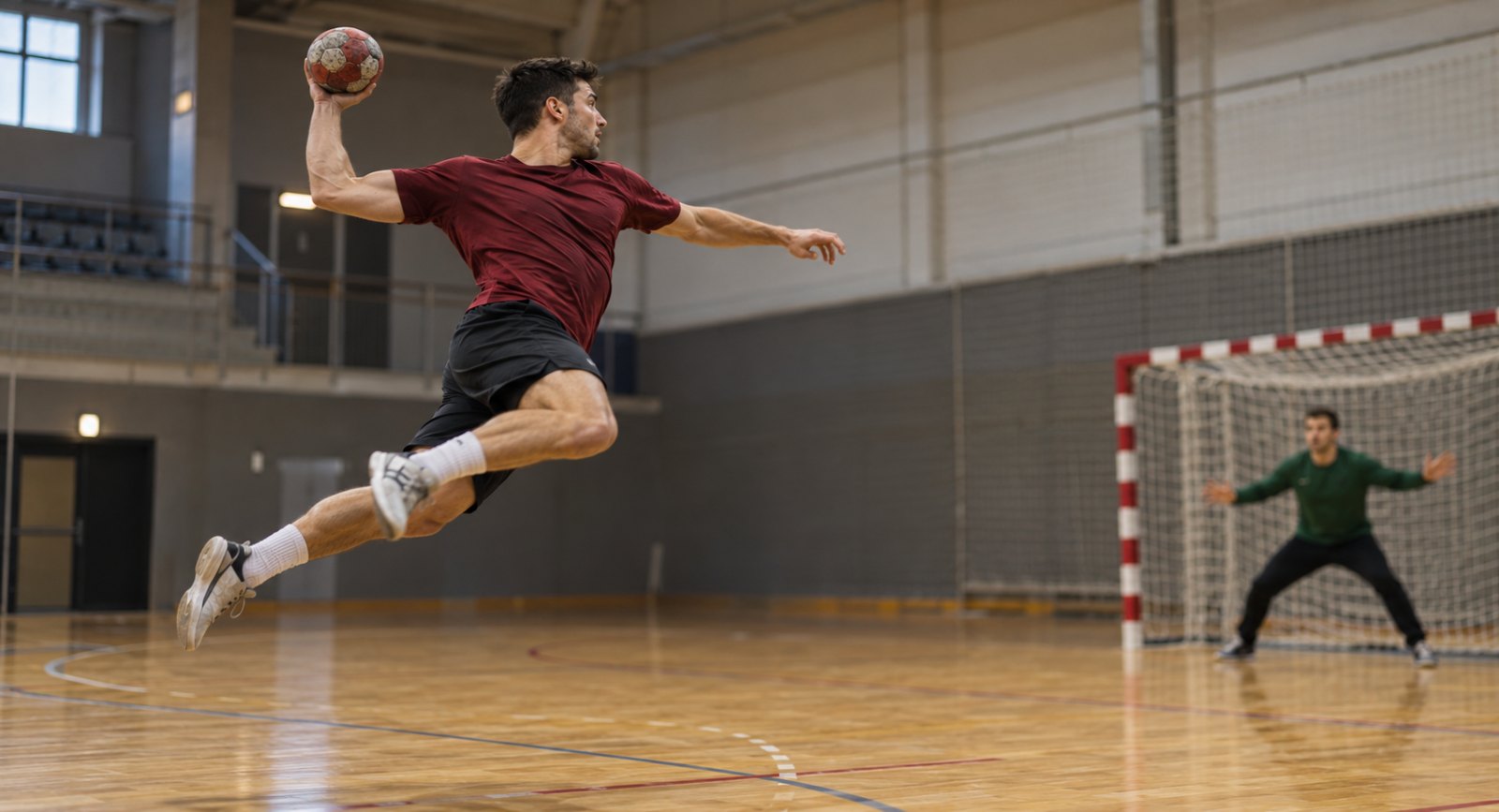
A handball throw lasts a fraction of a second. The arm has no time to apply maximum force, as happens in a heavy squat: what counts is how much force you put in, and fast. That is why velocity-based training is so appealing, because it forces you to move with the intention of accelerating, not just to pile weight on the bar.
The study does not prove that accelerating the bar is better than moving it heavy and slow. It proves something more modest: that in the short term, with this particular group, both routes worked equally well. For a coach, the practical reading is this: the intention with which you move the load weighs as much as the percentage of 1RM written on the training sheet.
What I would do with this on a team
This is my own judgement, not a result of the study, and I want to stress that.
Use bar velocity as a thermometer, not as dogma. If you have a sensor, use it to catch fatigue days and adjust loads on the fly. If you do not, relax: the useful conclusion still stands, there is no single "magic zone" for improving throwing with a pushing exercise.
Combine stimuli. Work with moderate-to-high loads for strength, work with light loads and maximum intent on speed. The study suggests both routes go a long way, so it makes no sense to bet everything on one card.
Train the whole chain, not the isolated muscle. Trunk rotation, legs, hips, scapular stability: all of that has to go with the press. A strong shoulder on a weak trunk throws less and gets injured more.
Measure before and after, with real control. If you want to know whether your programme works, repeat the same throwing measurement at the start and at six or eight weeks, and compare yourself with players who have not done the programme. It is the only way not to fool yourself.
And look after the shoulder. It is a joint that suffers a lot in this sport. There are reviews and trials on shoulder and knee injury prevention programmes (se abre en otra pestaña) in handball players; before adding more load, make sure the team's preventive work is really working.
Conclusion
The study does not say it does not matter what you do, and reading it that way would be a mistake. What it shows is that, in young players, two very different ways of moving the bar gave similar improvements in throwing velocity in the short term. For a coach, that is good news: there is plenty of room to design flexible sessions. For whoever sells the miracle method, it is a warning: if everything works the same in five weeks, the secret is not in the trick. It is in training consistently, measuring and progressing.
My advice: try, measure, and do not marry any method until you see your own data.
Sources consulted
- Abuajwa H.E. et al. (2022). The effect of high and low velocity-based training on the throwing performance of collegiate handball players. PeerJ 10:e14049: peerj.com/articles/14049 (se abre en otra pestaña).
- Effects of core training in handball players (systematic review and meta-analysis, BMC Sports Science, Medicine and Rehabilitation): link.springer.com (se abre en otra pestaña).
- Shoulder injury prevention programmes in handball (systematic review with meta-analysis): pubmed.ncbi.nlm.nih.gov (se abre en otra pestaña).
