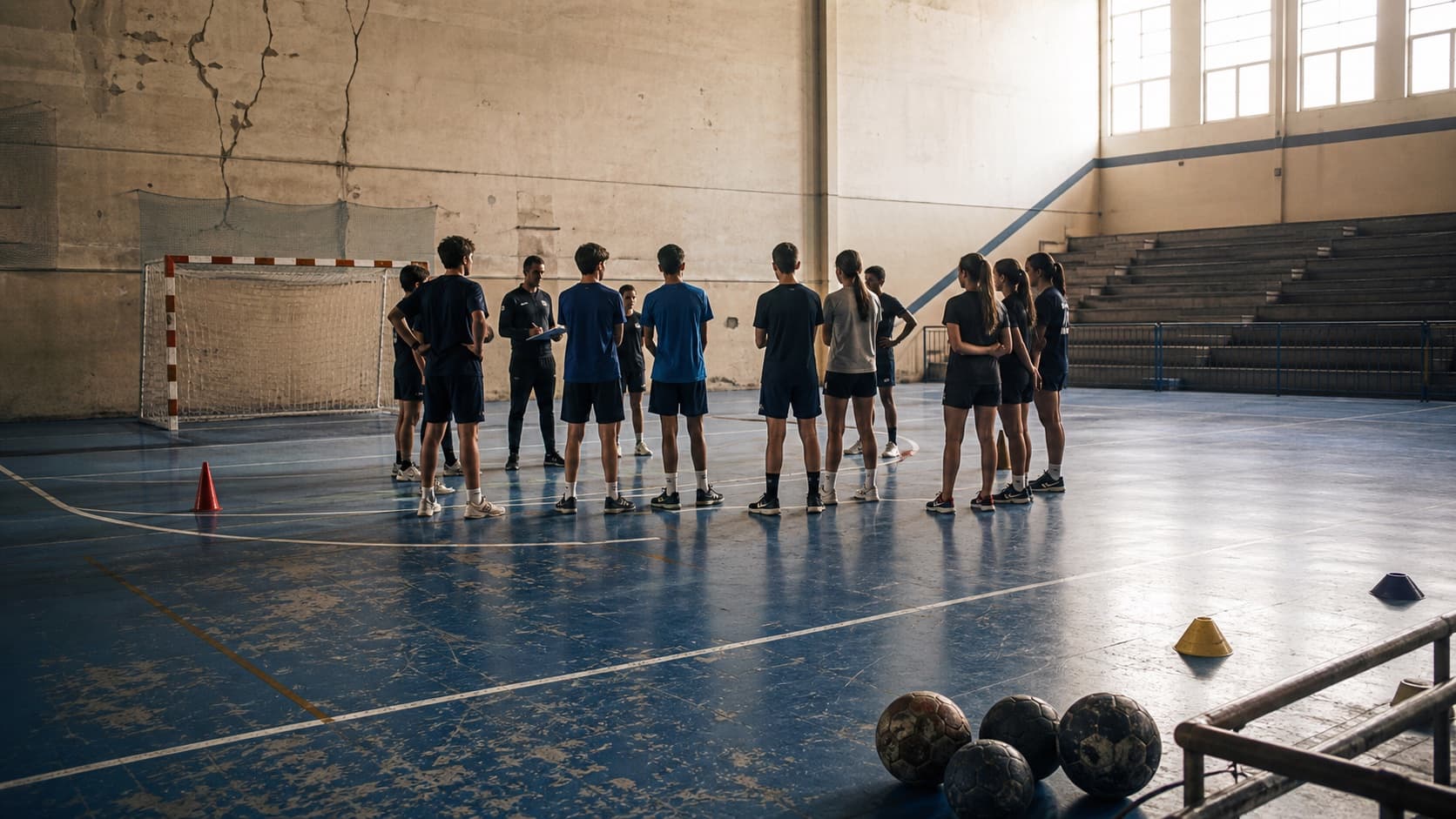

To understand why Spain keeps competing for international handball medals, it is not enough to look at Barça, the ASOBAL League or the big European nights. You have to go down several steps. You have to walk into the neighbourhood sports halls, the schools, the courts where parents set up tables, coaches correct footwork and kids learn to defend a two-on-two before they learn to celebrate a goal looking at the stands.
Spanish handball is not explained from the elite alone. It is explained from its base. From a network of clubs that often work with few resources but with a very strong training culture. Much of the secret is there. On the tactics board, in repetition, in insistence and in a very Spanish way of understanding the game.
The map is much richer than it seems. There are structures with obvious competitive muscle, such as FC Barcelona. There are almost artisanal projects that are already a national reference, such as Balonmano Dominicos Zaragoza. There are women's schools with their own stamp, such as Aula Valladolid. There are historic clubs that have turned youth development into culture, such as Granollers, Cangas, Zarautz, Anaitasuna, Elche, Montequinto, Sanse, Alcobendas, Prado Marianistas or Agustinos Alicante.
Not all of them train in the same way. Not all compete with the same resources. Not all have the same volume. But all of them help explain one reality: Spain produces talent because it still has a network of clubs that understands youth coaching as a craft.
Barça: the academy that wins through structure, method and demand
FC Barcelona has to appear in any serious feature on youth handball. Not so much for the number of kids, but for results, competitive demand and the ability to take young talent into contexts of maximum pressure.
The 2025-2026 season makes it clear. The Barça men's juvenile (under-18) side was crowned Spanish champion after beating Prado Marianistas 34-20 in Ciudad Real. That same year, the Infantil A (under-14) side also became Spanish champion after beating Bathco Torrelavega 27-23. The club itself highlighted that its juvenile team had won the Catalan League, the Spanish Cup and the Spanish Championship, as well as qualifying for the final four of the EHF Youth Club Trophy. (Source: FC Barcelona (se abre en otra pestaña))
Barça plays in another dimension. It is not a neighbourhood academy in the classic sense. It is a professionalised structure. It has pull, methodology, facilities, visibility and a performance chain that runs from infantil to juvenil, from juvenil to the reserve team and from the reserve team to the first team or the professional market.
That does not take away from its formative value. Quite the opposite. Its merit lies in sustaining daily demand. In teaching how to win under pressure. In developing players who understand high tempo, the counterattack, tactical reading and the responsibility of wearing a shirt that almost always starts as favourite.
Barça is not the most romantic academy in Spanish handball. It is an academy that measures you. And that also forms. Because talent alone is not enough to survive there. You have to compete every week with the obligation to win, live with constant comparison and understand that any match can be read as an exam.
BM Dominicos Zaragoza: the school that has become a giant
If Barça represents the power of a total structure, Balonmano Dominicos Zaragoza represents something else: the strength of a school-based model that has grown to contest national titles with anyone.
What happened in 2026 is not a flash in the pan. It is a signal. Dominicos was crowned Spanish under-16 men's champion after beating Barça 28-27 in the final played in Palma del Río. The win carries great symbolic weight because it confirms something that was already visible: the Zaragoza club does not just compete well. It now wins championships. (Source: Cartv (se abre en otra pestaña))
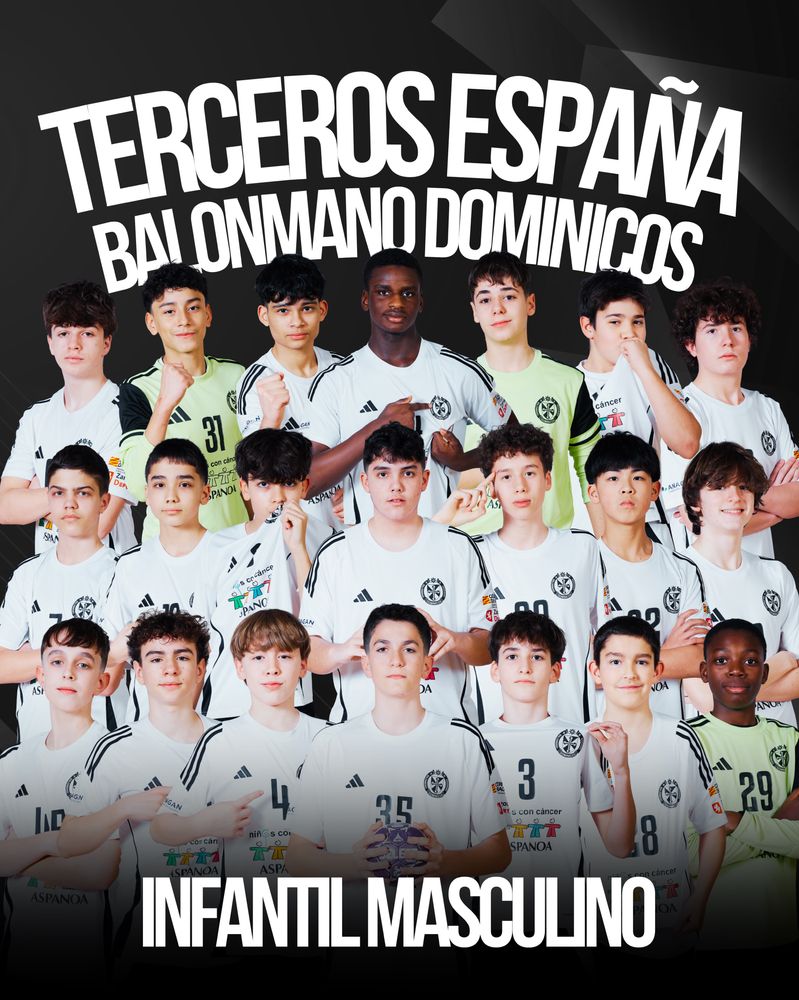
The Dominicos case is especially interesting because it was not born from a large professional structure, but from the environment of a school. That root explains a lot. The player does not simply arrive at a club. He grows up inside a community. He shares class, playground, trips, training sessions and tournaments. That coexistence creates chemistry, collective memory and automatisms that cannot always be manufactured with signings or recruitment.
On court it translates into teams with a tactical richness that is unusual at such young ages. Dominicos usually competes with brave defences, a lot of off-ball activity, good reading of space and a competitive capacity that does not depend solely on physique. They are not always the biggest. They are not always the strongest. But they play as if they had spent years solving the same problems together.
That is their great value. Talent appears, but it appears within a structure that organises it. And when a school manages to have its teams compete naturally against the country's big academies, the message is powerful: in Spanish youth handball you can still build from a sense of belonging.
Aula Valladolid: Pajarillos as a school of identity
Aula Valladolid is one of the great references in Spanish women's handball. And it is so for something deeper than results. The club has built a very recognisable way of competing, based on running a lot, attacking early and developing players with a very natural reading of open space.
In 2026, Cavidel Aula Valladolid Cadete Femenino A won the Minicopa de España after beating KH-7 Granollers with authority, 48-24, in the final played in Illumbe. The scoreline was striking, but what mattered most was the manner: a team able to break the match open through tempo, defence and a quick transition into the opposing half. (Source: RFEBM (se abre en otra pestaña))
The success did not stop at the Minicopa. On 7 June 2026, Cavidel Aula made history again by being crowned Spanish under-16 women's champion in Valladolid. Two national titles in less than a month, confirming the strength of its academy and the continuity of a model that can no longer be explained as an isolated generation. (Source: El Norte de Castilla (se abre en otra pestaña))
Aula does not hold back. Its teams usually play at a high tempo, look for the counterattack as soon as the chance appears and give great importance to the first wave. That way of understanding the game has marked several generations of players and has become a hallmark of the club.
There is also an emotional component that weighs heavily. Pajarillos is not a backdrop. It is part of the story. Over the years Aula has built a very strong relationship between neighbourhood, academy and first team. That generates something hard to measure: girls who see a path. Who can look up and feel that the elite is not so far away.
That is Aula's great value. It does not limit itself to producing competitive teams. It develops players who understand handball through speed, courage and belonging.
KH-7 BM Granollers: the tradition that never goes out
Granollers is a big name in Spanish handball. It needs no introduction. Its strength lies in continuity. In a city where this sport is not just another extracurricular activity, but a recognisable part of the local sporting culture.
Granollers is not explained by one particular generation. It is explained by decades of work, by youth coaches, by the sports hall and by a very Catalan way of understanding development: technique, versatility, tactics and competition. Its academy has been one of the country's references for years because it manages to sustain competitive teams in different categories, in both men's and women's handball.
Granollers' value lies in continuity. In appearing regularly in youth competitions. In developing players able to fill several roles. Centre backs who can play as backs. Backs who understand the relationship with the pivot. Defenders who don't just collide, but read.
That versatility is gold for the elite. At developmental ages it keeps the player from being pigeonholed too early. And in higher categories it eases adaptation to more demanding contexts. Granollers has been doing this naturally for many years. That is why it does not have to prove it is an academy. It has been one all its life.
Montequinto: the Seville academy that deserves more attention
Balonmano Montequinto has to be on this map. And not as a minor note. The Dos Hermanas club maintains a broad youth structure and benchmark senior teams. Its importance lies not only in competing. It lies in offering continuity and a pathway to players who, without that close environment, could get lost in the jump from adolescence to adult handball.
In 2026, Helvetia Montequinto won the CADEBA under-16 women's title after winning the Andalusian final phase. The Andalusian Federation highlighted its defence, its effectiveness in attack and its control of the match from the first half. (Source: Andalusian Handball Federation (se abre en otra pestaña))
Montequinto matters for several reasons. First, because Andalusia is growing a great deal at youth level. There are more and more clubs able to compete outside their own territory. There are more and more players with the level to make the leap. And there are more and more coaches working with a serious developmental outlook.
Second, because Montequinto works in a less high-profile context than Catalonia, Castilla y León, Madrid or the Valencian Community, but with a very real competitive capacity. Projects like this are essential so that Spanish handball does not always depend on the same spotlights.
And third, because it has the profile of a bridge club. It trains, competes, sustains senior teams and offers continuity. That detail is key. Many academies spot talent. Far fewer manage to retain it, give it a sense of belonging and accompany it when the hardest years arrive. Montequinto is building an answer to that problem.
Cangas and the Galician gene: competing from identity
Galicia has a very special relationship with handball. And Cangas is one of its emotional capitals. The Morrazo breathes this sport in a very particular way. O Gatañal is not just a sports hall. It is a school of competitiveness.
The youth sides of Cangas and Luceros appear frequently in national championships, and Galician handball maintains a notable presence in national youth phases. Not always with the spotlight of the big structures, but with a very serious capacity to produce competitive players.
The Galician player usually has a recognisable stamp. He is intense, tough, ready to compete and used to matches where every ball counts. He does not always come out of giant structures. He comes out of sports halls where every training session is competitive and where the stands are also part of the learning.
Cangas, Bueu, Luceros, Carballal, Lalín and Teucro are part of that geography where handball has roots. There, kids learn early that defending is also playing. They learn to suffer, to interpret contact, to read small advantages and to compete without needing big stages.
That Galician gene is very valuable to Spanish handball. It does not always produce the most spectacular player. It often produces something just as necessary: the reliable, competitive player with craft, ready to survive in uncomfortable matches.
Zarautz ZKE: the other Gipuzkoan laboratory
Gipuzkoa has a special relationship with handball. Irun represents the great history, the European Cup and the direct link to the elite. But if we talk about the base, pure youth development and a club that breathes from the bottom up, Zarautz ZKE deserves a place on this map.
Zarautz has that profile of an academy that does not need big spotlights to be recognised by those who follow youth handball. It is a big-village club, with identity, a sports hall, continuity and a clear idea: to develop players from a sense of belonging. There handball is not a passing activity. It is local sporting culture.
Its value also lies in the competitive context. In Gipuzkoa nobody gives anything away. Between Bidasoa, Usurbil, Tolosa, Ereintza, Pulpo, Zarautz and other nearby hubs, every generation grows up playing demanding matches from very early on. That shapes players with craft, intense defenders, ready back-court players and a very recognisable tactical reading.
Zarautz does not have Irun's European showcase or Barça's machinery. But it has something that is worth a great deal at youth level: continuity, roots and a community that understands handball as part of its identity.
When we talk about developing players, that weighs more than it seems. Because an academy is not built on talent alone. It is built on habits, coaches, families, nearby rivals and a weekly competition that forces you to improve.
Sanse, Alcobendas and Madrid: volume, recruitment and competitive tempo
Madrid has something other regions do not have: volume. A lot of volume. And in youth handball that can become a decisive advantage if there is structure, coaches and continuity.
Sanse and Alcobendas represent two very interesting paths in the central area. They are clubs with recruitment, proximity, weekly work and a demanding regional competition. They do not always have the showcase of the big names, but they do have a sufficient base to produce players with legs, shooting and tempo.
Madrid does not always dominate the national medal tables, but it frequently fields awkward teams. Teams that compete well. Teams that force the opponent to play with concentration. That speaks of competitive health and of a mass of participants that, well organised, can generate talent.
The Madrid profile usually has an important physical edge. Backs who can shoot. Centre backs with tempo. Teams used to playing many demanding matches over the season. At developmental ages, that exposure speeds up competitive learning.
Sanse and Alcobendas fulfil a key function: they absorb local talent, organise it and expose it to contexts of maximum demand. That is no small thing. In a region with so many sporting alternatives, sustaining a strong handball academy is already a victory.
Anaitasuna and Navarra: discipline, school and players with craft
Navarra deserves a chapter of its own. For Anaitasuna, for Beti Onak, for Malkaitz, for Loyola and for a very solid development culture, especially in women's handball.
At CESA 2026, Navarra appears as Spanish under-16 women's champion, with a selection made up of players from clubs such as SCDR Anaitasuna, Beti Onak, Loyola or Malkaitz. That fact is important because it confirms that Navarra does not live off a single club. It lives off an ecosystem.
Anaitasuna provides structure, facilities and club culture. Beti Onak adds a widely recognised women's tradition. Malkaitz and Loyola complete a development network that lets the region stay competitive year after year.
The Navarrese profile is usually very interesting. Players who are tactically reliable, with a good defensive culture, competitive, used to tough matches and able to take on roles. They do not always make the headlines, but when they reach regional or national teams the earlier work shows.
Navarra teaches an important lesson: an academy does not depend solely on having a dominant club. Sometimes it depends more on a well-connected environment, where several projects push in the same direction and generate an internal competition that raises the level.
Elche, Agustinos Alicante and Morvedre: the Valencian school never went away
The Valencian Community is another silent powerhouse. It has tradition, historic clubs and a very strong relationship with women's handball. Elche is one of the best examples, but not the only one.
Ahead of the 2026 Copa del Rey final phase, Cadena SER highlighted the presence of several players trained at Club Balonmano Elche in the participating teams: Ian Moya, Carlos Pérez, Juanpe Espinosa, Pepe Oliver and Adrián Nolasco. José Francisco Nolasco, an Elche coach and a figure with a long track record, also appeared. That is one of the best indicators of an academy: not only competing at infantil or cadete level, but placing players in the elite. (Source: Cadena SER (se abre en otra pestaña))
Agustinos Alicante also deserves a place on this map. It is one of those projects with school roots, its own identity and a regular presence in youth competitions. Morvedre, for its part, has spent years doing very good work in women's handball, with a clear link between the youth base and the senior structure.
The Valencian school has variety. Elche, Morvedre, Mislata, Agustinos, Elda, Benidorm or Algemesí form a map with a lot of weight. In women's handball, moreover, the Valencian Community has a very strong competitive tradition.
There is talent and craft here. There are goalkeepers, wings, back-court players, players with a lot of tempo and players who understand the game from an early age. The Valencian Community has spent years showing that its place in Spanish youth handball is not circumstantial.
Prado Marianistas: the value of a school that competes against giants
Prado Marianistas is another name that has to be added. Its men's juvenile side were Spanish runners-up in 2026 after losing to Barça in the final. The result was clear, 34-20, but the value of reaching a national final from a school structure is enormous. (Source: FC Barcelona (se abre en otra pestaña))
This kind of club is essential for Spanish handball because it shows that the school is still a very powerful route for development. Dominicos in Zaragoza, Marianistas in Ciudad Real, Agustinos in Alicante or Maristas Algemesí are part of that tradition in which the sport is born very close to the classroom, the playground and the educational community.
Many of the best youth projects are not born from a professional structure. They are born from an environment where the child starts playing with friends, finds committed coaches and grows within a group that gives him continuity.
Prado Marianistas represents that idea. A team that competes against giants from a development structure. A club that shows that method, continuity and identity can take you to a national final.
In an increasingly demanding sport, that route remains fundamental. Because it reminds us that developing players does not consist only of selecting the best one early. It also consists of creating an environment where many can improve over the years.
The Canary Islands: women's talent, distance and a growing competitiveness
The Canary Islands also deserve a place. For geographic difficulty, for tradition and for their capacity to produce players with a competitive character.
Canarian handball competes with an added obstacle: travel. The calendar. The distance. The need to go away to measure themselves against the big mainland hubs. All of that makes processes more expensive and demands very careful organisation.
And even so it produces talent.
San José Obrero, Rocasa, Zonzamas, Puerto del Carmen, Tahiche or Moya are part of an ecosystem that has given a great deal to Spanish women's handball. The Canary Islands have a school of fast, competitive players, used to solving things in open space and with a very marked culture of effort.
Their merit lies in sustaining a level despite the distance. In producing competitive teams with less opportunity to measure themselves every week against the big national hubs. And in maintaining a women's tradition that has fed Spanish handball for years.
The Canary Islands are not a footnote. They are a territory that forces us to look beyond the centre of the peninsula.
Trops Málaga, ARS Palma del Río and the south that is pushing
The south is also changing the map. Not only because of Montequinto. Also because of projects such as Trops Málaga, ARS Palma del Río, Maravillas Benalmádena or the clubs of Córdoba and Málaga that are raising the level of regional competition.
Andalusia has an obvious advantage: territorial volume and plenty of room to grow. For years it did not always have the same visibility as Catalonia, Castilla y León, Madrid or the Valencian Community. But the situation is changing.
There are more and more clubs with structure. There are more and more teams in final phases. There are more and more Andalusian players with a presence in national teams and projects.
Montequinto is the most obvious name right now, but not the only one. Maravillas Benalmádena has also appeared in women's final phases. Palma del Río maintains a very strong tradition. Málaga has gained presence in national categories.
The south is no longer the periphery. It is a growing hub. And for Spanish handball that is excellent news, because it widens the map, multiplies opportunities and stops youth development depending always on the usual territories.
Why Spain develops handball players so well
The underlying question is simple: why does Spain, without the budgets of Germany, France, Denmark or Hungary, keep turning out competitive players?
The answer has several layers.
The first is tactical. In Spain the game is trained a lot. From an early age they are taught to read, not just to execute. The child learns to decide, to fix, to release, to defend an odd-man situation, to run a first wave and to understand when to accelerate and when to stop.
The second is emotional. Many youth clubs are communities. The player belongs. He doesn't just train. He lives the club. That creates commitment, continuity and a deeper relationship with the sport.
The third is competitive. The regional phases are tough. The national sectors are very tough. And the Spanish Championships force you to play against very different styles. An under-16 from Zaragoza may face a Catalan team, a Galician one, an Andalusian one and a Madrid one within weeks. That diversity forms players.
The fourth is vocational. Spanish handball still depends on coaches who work many hours out of passion. Invisible professionals who teach footwork, defensive movement, trajectories, habits and small details that do not show up in the statistics.
The fifth is cultural. In many places, the sports hall is an extension of the neighbourhood, the school or the village. Cangas, Zarautz, Granollers, Pajarillos, Dominicos, Montequinto, Elche, Sanse or Anaitasuna are not just club names. They are environments. And the environment also trains.
Honour roll of the great academies of Spanish handball
| Club or territory | Strength | Relevant recent result | Profile it tends to produce |
|---|---|---|---|
| FC Barcelona | Performance, recruitment and demand | 2026 Spanish men's juvenile and infantil champion | Complete, fast players used to winning |
| BM Dominicos Zaragoza | School-based model, chemistry and tactics | 2026 Spanish under-16 men's champion, beating Barça | Smart centre backs, active defenders, players with nerve |
| Aula Valladolid | Women's development and attacking tempo | 2026 Spanish and Minicopa under-16 women's champion | Fast back-court players, aggressive wings, transition players |
| KH-7 BM Granollers | Tradition, versatility and method | Regular presence in men's and women's final phases | Tactical, versatile players with good reading |
| BM Montequinto | Andalusian growth and continuity | 2026 CADEBA under-16 women's champion | Intense, disciplined and competitive players |
| Cangas / Luceros / Bueu | Galician identity and defensive culture | Regular presence in national sectors and phases | Tough defenders, ready back-court players, players with character |
| Zarautz ZKE | Local identity, Gipuzkoan academy and strong regional competition | Youth reference in Gipuzkoa | Competitive, tactical, intense players with a defensive culture |
| Sanse / Alcobendas | Volume and recruitment in Madrid | Competitive presence in national youth championships | Powerful backs, physical players and high tempo |
| Anaitasuna / Navarra | Women's ecosystem and tactical discipline | Navarra, 2026 CESA under-16 women's champion | Organised, reliable players with craft |
| Elche / Agustinos / Morvedre | Valencian tradition and a route to the elite | Several Elche-trained players in 2026 Copa del Rey teams | Technical players, goalkeepers, wings and quality back-court players |
| Prado Marianistas | Competitive school | 2026 Spanish men's juvenile runners-up | Players developed as a block, with tactical culture and belonging |
| Canary Islands | Women's talent and competitiveness despite the distance | Historic territory in women's development | Fast, competitive players with character |
| Andalusian south | Territorial growth and more national presence | Montequinto, Maravillas, Málaga and Palma del Río as active hubs | Intense players with physique and competitive room to grow |
Conclusion: the Spanish secret is not only in winning, but in developing differently
Spain does not compete in handball by chance. Nor because of money. It competes because it has a development network that is hard to replicate.
Barça sets the competitive ceiling. Dominicos shows that a school can beat a giant. Aula Valladolid shows that a playing identity can be born in a neighbourhood and win championships. Granollers sustains the tradition. Montequinto pushes from Andalusia. Cangas and Galicia remind us that character is also trained. Zarautz represents that Gipuzkoan academy that grows from the roots. Sanse and Alcobendas take advantage of Madrid's volume. Navarra produces tactically mature players. The Valencian Community keeps manufacturing talent. And schools such as Prado Marianistas or Agustinos confirm that Spanish handball still keeps something precious: youth coaches who really teach.
That is the heritage. Not the result of a final. Not an isolated medal. Not a single name. The heritage is that a boy from Zaragoza, a girl from Valladolid, a centre back from Zarautz, a goalkeeper from Navarra, a back from Montequinto or a wing from Elche can grow up in an environment where handball matters.
There are the cathedrals. Some have enormous trophy cabinets. Others have leaky roofs, parents in the stands and coaches who arrive from work with a folder under their arm. But all of them sustain the same miracle: that Spain keeps developing players able to compete against countries with more money, more professional structure and more financial muscle.
The difference is in the mud. And in the mud, Spain is still a powerhouse.
