You can now enjoy the full episode with which Liftados kicks off its third season. Gorka Cabañas and Dani Cabado debut a new format, with more chat, new sections and a polished script, and face, for the first time on the podcast, the loneliness of having no guest: just the two of them, face to face, talking about what Spanish handball is missing, reviewing the latest in Asobal and the Liga Guerreras Iberdrola and closing with a new section that promises to give a lot of play.
The third season kicks off: what is Spanish handball missing?
Gorka and Dani open the year being self-critical. They don't talk about money ("it's obvious it's lacking, we don't need to say it"), but about something they believe weighs even more: imagination. The sport needs to be told better.
The figure that sums it up: last season Barça played 30 Liga Asobal matches and won all 30. Sixteen leagues in a row. Almost nobody outside handball knows it, and for Liftados that is not a budget problem, but a matter of how a sport is communicated that, they say, offers images as spectacular as few others.
The editorial conclusion: handball needs stars willing to show their face off the court, not just on it. They give the example of Dani Fernández, Barça's wing, explaining in a documentary that in Germany he had to travel kilometres to record content with kids from other clubs, whereas in Barcelona he can focus just on playing. For Gorka and Dani, that is exactly the gap where the push has to start.
New format: chat, fixed sections and a polished script
This third season arrives with a revamped format. There will be more chat between the two of them and sections that will repeat episode after episode, alternating between two blocks: "Protein Shake" and "Steps and Other Fouls", each with its own content and its own debate dynamic.
They also confirm the season's first collaborators: Jaime Suárez, a handball player and professional nutritionist who works with high-performance athletes, joins to talk about nutrition, and proven coaches will also come to debate with them.
The Liftados hoodie and the Stratio Sport sponsorship
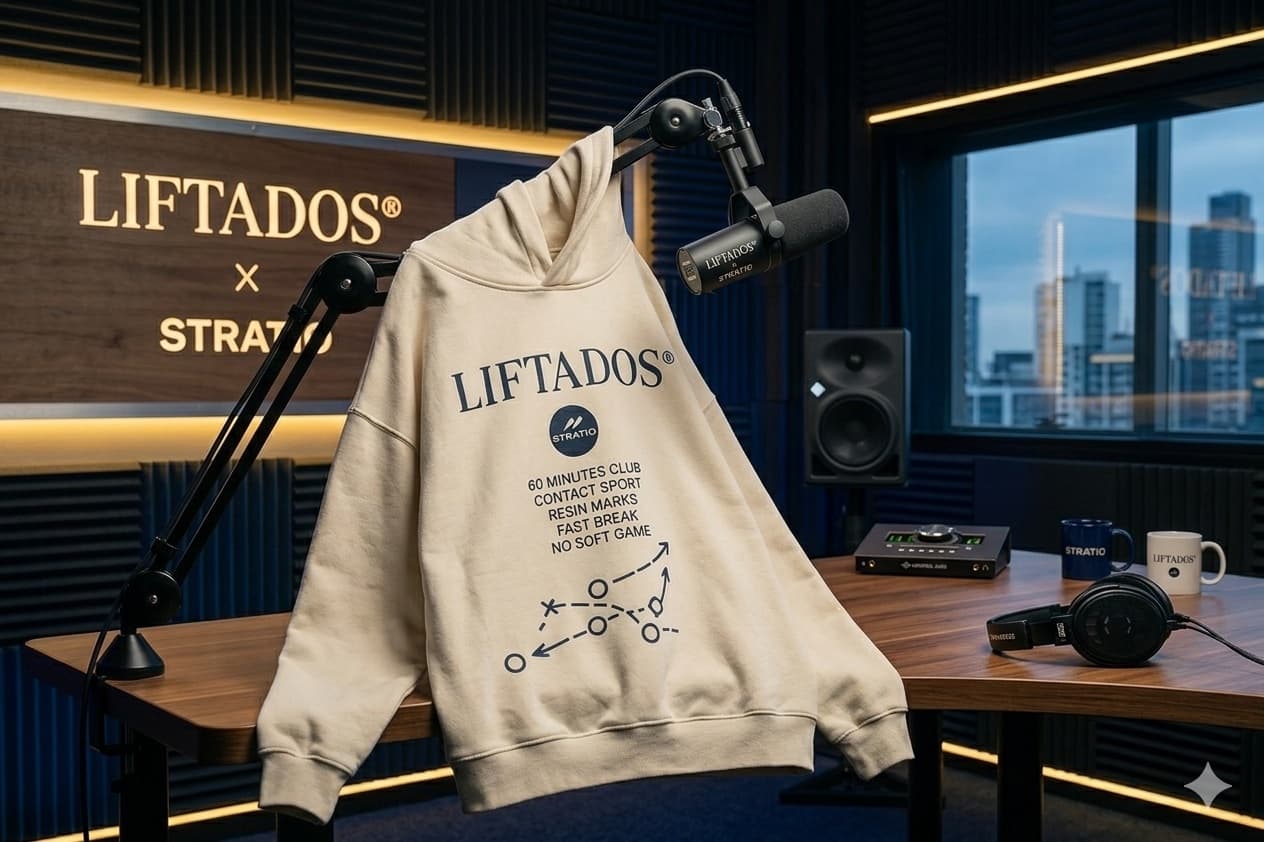
Live on air, Dani pulls out the Liftados hoodie, the result of the collaboration with Stratio Sport, a Madrid brand founded by someone from the handball world and a partner of the house this season. Heavy weight, terry lining, kangaroo pocket with a hidden detail and not a single mention of the word "handball" in the design: the idea is that it works as streetwear, not as a kit.
The piece is the first release of the 60 Minutes Club (se abre en otra pestaña), in a limited run. If you are interested, you can see it in the Hoodie section of the website.
News: Montpellier changes venue to host Barça
In the news section, Dani brings two curious stories. The first: on the last matchday of the men's Champions League, Montpellier moved its match against Barça to an 8,500-seat arena, well above the 3,000 of its usual venue. Gorka does some quick maths: with an average ticket of €30-50, the gate for that match could have been around €200,000-250,000, a huge figure for handball.
Both agree it is a logical move: facing the best team in the world with a fan base that responds. They compare it with what Vidasoa already tries in Irún, occasionally moving venues to fit more people at big matches.
Gonzalo Pérez de Vargas, players' representative before the EHF
The second story: Gonzalo Pérez de Vargas has been chosen to represent the players before the EHF, as part of a rotating group of seven athletes (three women and three men) that also includes Blažič, Ana Gros, Andrea Lekic and Rasmus Lauge, among others. Gorka takes the chance to tell a personal anecdote about the Barça goalkeeper in the stands at a Bidasoa-Barça, and both agree that his profile, serious, a leader by example and Barça captain for years, fits the role perfectly.
Is it bad to know who will win the Liga Asobal?
The first big debate: is it a problem that fans know, before it starts, who will win the Liga Asobal? Dani is clear from the fan's point of view: it is negative to know not only who wins this season, but who will probably win the next five. The solution, richer squads in the rest of the teams, is not realistic in the short term without a well-managed financial injection.
Gorka compares it with football: Real Madrid and Barça have dominated La Liga for 25 years and the product still fills stadiums, because there are real prizes and incentives for fighting for the other positions. His proposal: look for formulas, such as prize money by final position, that give meaning to competing for fifth or eighth place in Asobal, since a final play-off would not change who takes the title in the short term either.
The promoted sides raise the level, and the Liga Guerreras Iberdrola remains the most balanced
Second debate topic: the newly promoted sides in Asobal (Sevilla with Cajasol behind them, Puerto Sagunto with Fertiberia and Ciudad Real, who return to the elite step by step) are raising the overall level of the competition, something both read as a good sign of how work is being done below the top category.
By contrast, they review the Liga Guerreras Iberdrola: even though the Asobal Barça has won 16 leagues in a row, the women's league has had three different champions in the last four years (Málaga in 23, Bera Bera in 24-25 and Rocasa in 26), which makes it an example of competitiveness that Asobal does not yet have. They close the block with the Cangas-Bidasoa controversy, decided by a centre throw claimed by Cangas, which Dani did not hesitate to call "the spice" that also hooks fans.
Sponsorship, social media and how to tell the story of handball better
The longest block of the episode. Gorka argues that much of today's sponsorship in handball still works as patronage: a brand "does a favour" for its hometown team, instead of making an investment with a real return, and that this holds back the sport's revenue growth.
The solution they propose does not require big budgets: turning the lights off during timeouts, short interviews at half-time, cameras in the dressing room, mini season documentaries put together with what is already being recorded. They give as examples the Spanish skater Dani León, who constantly uploads high-quality content and has collaborated with Red Bull and Atlético de Madrid without needing big productions, and the PSG youth teams, whose YouTube summaries work, they say, like a Netflix documentary in miniature.
They also talk about which Spanish players have the "hook" to build a personal brand: they mention Ian Barrufet as an example of a player who hooks people by how he lives and celebrates the game, and agree that more footballers... sorry, handball players are needed who are willing to exploit that charisma on social media.
The new section: the toughest seven in handball
They launch a section of "Steps and Other Fouls" with a draft by position for a seven that neither of them would show to their physio: the most physical and intense players on the current European scene. Amid laughs and anecdotes, this was the team they put together:
- Left wing: Dylan Nahi
- Left back: Ivan Martinović Conan
- Centre back: Magnus Jøndal
- Right back: Jorge Maqueda
- Right wing: Niklas Kirkeløkke
- Pivot: Johannes Golla
- Goalkeeper: Andreas Wolff
The review leaves some very Liftados moments: the anecdote of the kid who cleans his club's arena asking Dean Bombač (Bombac) for his shirt at a pre-season tournament, or the fact that Wolff bent Sylvester Stallone's arm in an arm-wrestling scene in an action film.
Full episode available now
This is how Liftados kicks off its third season: constructive criticism, a news section, a chat about Asobal and the Liga Guerreras Iberdrola, sponsorship, social media and a new section designed to spark conversation. You can now enjoy the full episode on YouTube and on all podcast platforms.
Available now
Full episode · #17 The third season kicks off
You can enjoy this Liftados episode on your favourite platform:
