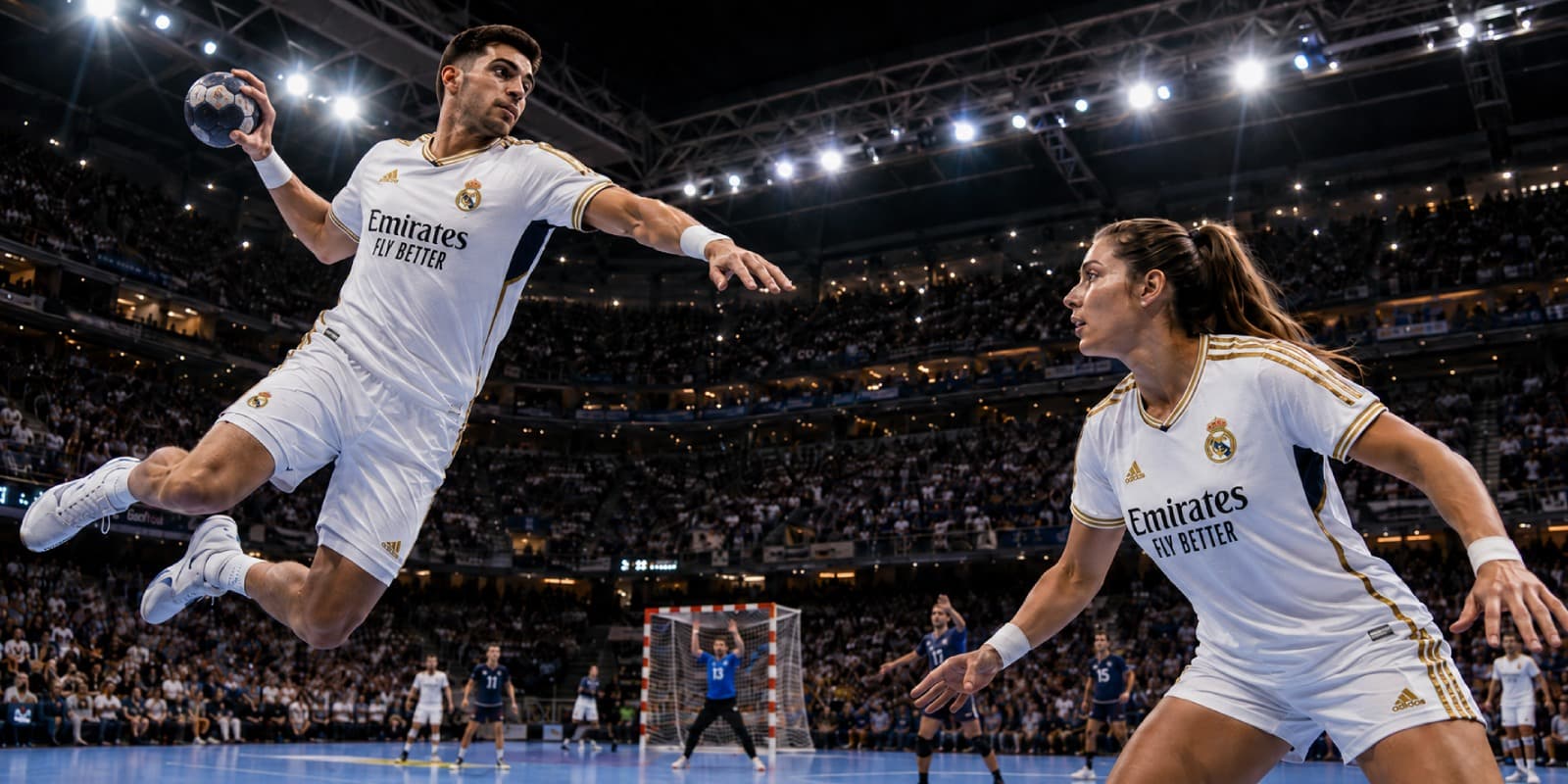

Every now and then the idea pops up on talk shows like wishful thinking, almost like a campaign device to stir up the white hornet's nest. With the Real Madrid presidential election approaching —with names like Enrique Riquelme on the table and dizzying guarantees of 193 million euros— the proposal to create a men's and women's handball section is floating around again.
For many, it is pure nostalgia. Romanticism from another era. For those of us who analyse sport from the angle of business, entertainment and brand impact, it is a masterstroke of strategy. It is not about reviving the past; it is about taking ownership of the future of a sport that already draws crowds in Europe and that in Spain is crying out for an electric shock.
The European mirror: football's giants are already making their move
In Spain we have grown used to thinking small about handball, accepting a Liga ASOBAL with an unbreakable glass ceiling caused by the absolute dominance of FC Barcelona (33 league titles and 12 European Cups back up its giant status). But you only have to look up and see what is happening on the continent this 25/26 season to understand that the ocean liners of European football are landing on the court.
Bayern Munich enters the game. Germany was already the undisputed mecca of this sport, but the landscape has just been turned upside down. Bayern Munich itself has just started the machinery to structure, professionalise and grow its handball section in a big way. The Bavarian giant wants to replicate the successful model it already applied in basketball: start from the bottom with serious resources to end up storming the elite. If the club most obsessed with financial rigour in Europe sees an opportunity here, the signal to the rest of the planet is unmistakable.
The Bundesliga boom and Cologne. The German league is not a niche; it consolidates averages that comfortably exceed 5,500 spectators per match. Meanwhile, Cologne's LANXESS Arena remains the great theatre of indoor sport, smashing historic records with more than 20,000 fans at the Champions League finals. Handball, well sold, is a premium spectacle.
The Portuguese mirror and the PSG model. In Portugal, handball is a mass success thanks to the transfer of identity from football. FC Porto, Sporting CP and Benfica treat the section as a real asset, injecting budget and filling European arenas. Meanwhile, in France, PSG Handball not only dominates its league but this very year, 2026, is expanding its global brand with international tours in Asian markets such as Japan.
10 million euros: pocket change in football, an earthquake in handball
In today's football ecosystem, 10 million euros barely covers an agent's commission or the annual salary of a rotation player. In handball, that budget automatically makes you a continental giant.
With that investment, a Real Madrid handball team would not be born to timidly ask for a seat at the table. It would be born with an ambitious project:
- An elite professional structure, a youth academy in the region and world-class coaching staffs.
- Immediate pull for international talent drawn by the magnet of the crest.
- The Movistar Arena as its stage, sending the forceful message that the aim is to fill a top-level venue in the capital, not a neighbourhood sports hall.
It would not be expected to beat Barça in the Champions League on day one —handball demands maturing— but the return on investment would not be measured only in trophy cabinets, but in narrative, new sponsors, audiovisual content and community.
The masterstroke: the women's section as a lever of disruption
If Real Madrid created only a men's team, the narrative would be predictable: wallet against wallet to try to dethrone Barça in the short term. A war of attrition.
However, the real commercial and social revolution would come from being born with a double structure: men's and women's.
Women's sport is no longer a charitable add-on or an image quota; it is the biggest lever of growth, content and modernisation for sports brands in the current decade.
By betting heavily on the Liga Guerreras Iberdrola, Real Madrid would change the rules of the game:
- Modern leadership. It would position itself as the most advanced project in Spain in terms of competitive equality and vision for the future, beating Barça itself to the story of modernity.
- Grassroots recruitment. Connecting with schools in Madrid, offering thousands of girls an aspirational elite mirror in the white shirt.
- Brands with purpose. A dual project of modern, urban handball is a gift for European marketing departments looking for stories that resonate with the new generations.
Spanish handball needs this Clásico
Let's be honest: it suits Barça too. Competitive monotony ends up putting sports products to sleep. The arrival of a Real Madrid handball team would force the whole national ecosystem to wake up. Television would win from the impact of the Clásico, players would win because the domestic market would gain value, and fans would win, finally feeling again the tension of an unpredictable league.
Real Madrid does not need the nostalgia of black-and-white photos to justify a handball section. The business data of this 25/26 season, the strategic moves of European rivals like Bayern or Porto, and the courage to understand that, sometimes, to expand a global empire you only need to look at the board with 21st-century eyes are enough. Forcing Spanish handball to think big would already be the first victory.
