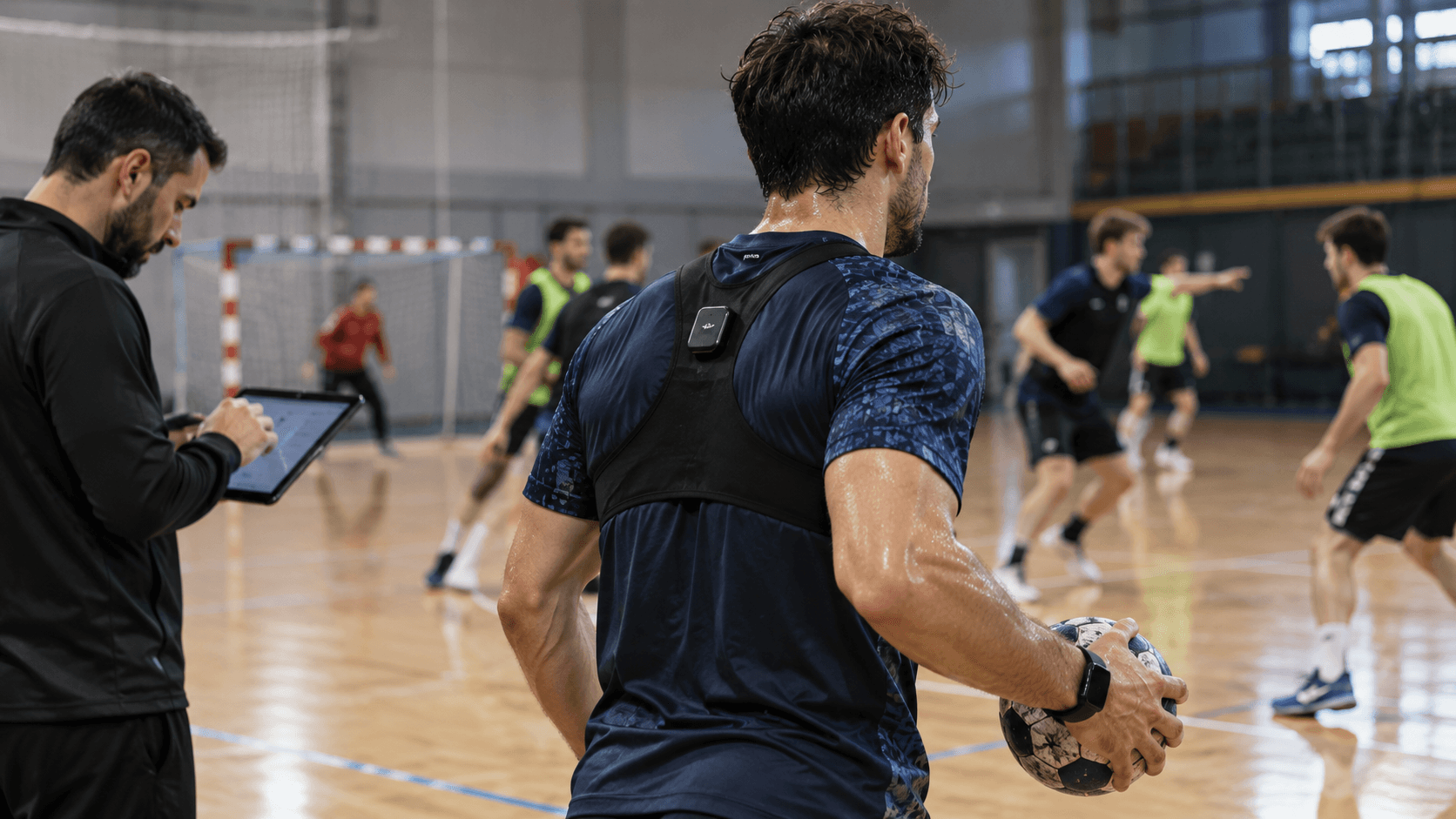

GPS watches and local positioning systems (LPS) are already routine in half of the German handball Bundesliga. In Spain, most ASOBAL clubs still train by eye. Three studies published in 2026 explain why that technological gap matters less than the brands claim, and more than the sceptics think.
Why this is news now
The Handball-Bundesliga (HBL) extended its agreement with Kinexon in 2026. Kinexon is the German supplier of ultra-wideband systems that already track the ball and players in real time at several of its clubs. While the German elite turns load data into day-to-day training management, three studies published this year in indexed journals (Journal of Human Kinetics and Frontiers in Sports and Active Living) put exact figures on what these systems measure well, what they measure badly and what they should not replace outright. It is time to talk about this with data, not with the sales pitch of the day.
What a wearable really measures on a handball court
Handball is not running. A GPS that works wonderfully for measuring distance in a half marathon faces, on a 40x20-metre court, constant changes of direction, jumps, contact and tight spaces where the satellite signal loses accuracy. That is why most reference indoor systems do not use GPS but LPS (local positioning by antennas) combined with inertial units (IMU): an accelerometer, gyroscope and magnetometer built into a vest or strap.
A study published in the Journal of Human Kinetics evaluated an IMU-based tracking system against an already validated LPS+IMU system, with 34 players from the German junior national teams (women's under-18 and men's under-21). Three training sessions with seven different drills were recorded, plus a simulated match.
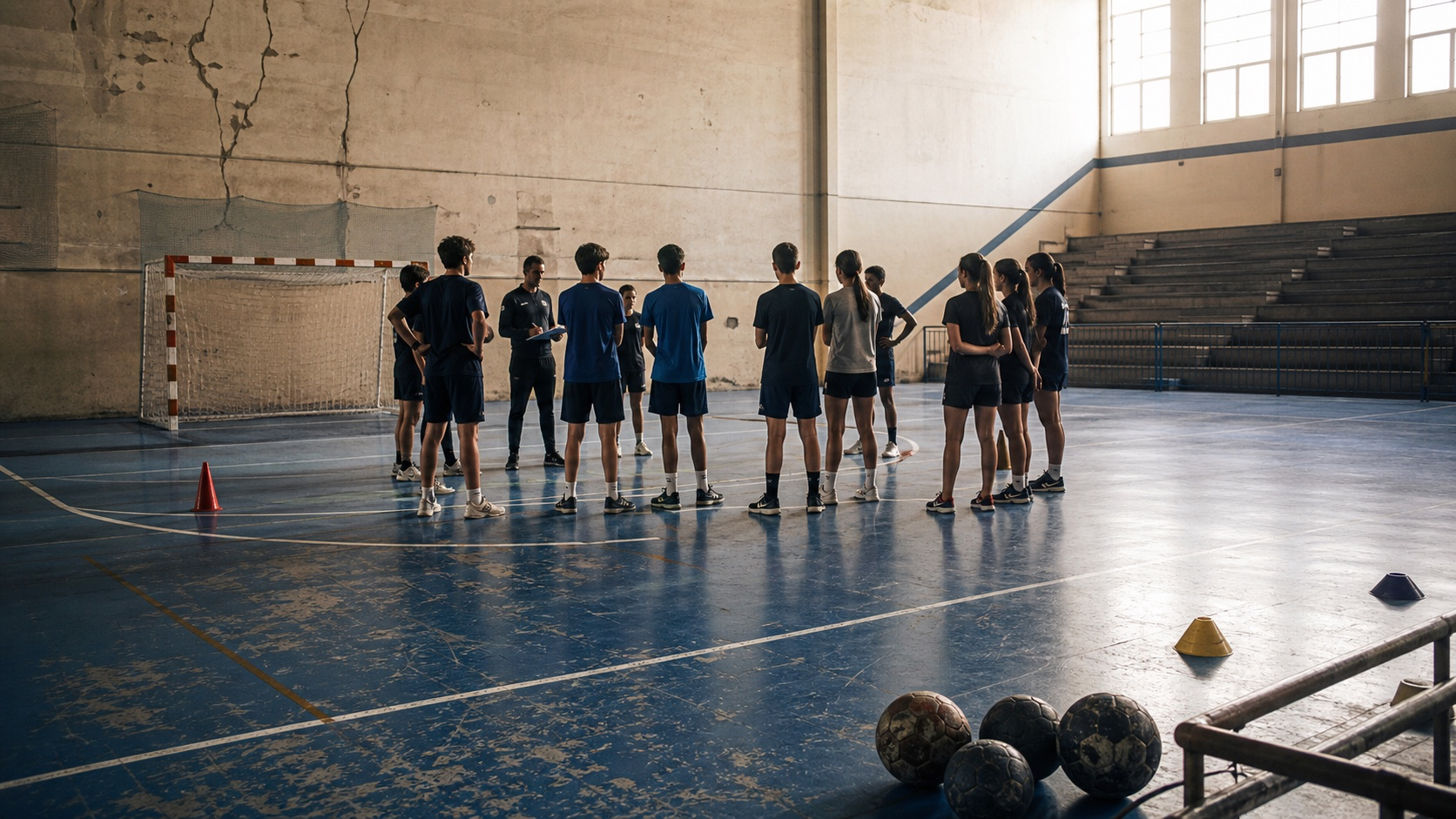
The result is nuanced, and that is where it gets interesting. The player's accumulated load (player load) and time in low-speed zones showed substantial agreement between the two systems (CCC above 0.95). But the researchers were clear in their conclusion: the recent IMU system "only allowed a valid assessment of the variables directly measured by the technology", that is, accumulated load. Speed-based metrics cannot be extrapolated with the same reliability.
Translated to the court: an affordable wearable will tell you quite accurately how much work a player has done in volume. It will not tell you with the same reliability at what intensity they did it. And that distinction, which sounds technical, is what separates a good load plan from a badly calibrated one.
The data that really prevents injuries
Where the technology does prove its worth is in aggregate work over a season. A study of 23 elite male handball players, also published in the Journal of Human Kinetics, used an ultra-wideband system over four months of competition to apply cluster analysis (k-means) to six external load variables: total distance, peak speed, accumulated acceleration load, number of efforts, maximum jump height and jumps above 0.30 metres.
The numbers are emphatic. Matches were 1.8 times more likely to be classified as a high-load session than training sessions, something any coach senses but which now has statistical backing. Even more relevant: when 15% or more of a week's sessions were high-load, the odds of a spike in the ACWR (acute:chronic workload ratio, the ratio of acute to chronic load that predicts injury risk) were multiplied by 10.7.
«When 15% or more of a week's sessions were high-load, the odds of an injury-risk spike (ACWR) were multiplied by 10.7.»
The study also found something that confirms what anyone who has coached a team knows by heart: wings and backs appear significantly more often in the high-load clusters than goalkeepers and pivots. Load in handball is not uniform by position, and a pre-season plan that treats the whole team the same is, by definition, badly designed.
This is what a well-used wearable offers that the coach's eye cannot: it does not replace judgement, but it makes it possible to detect ten days earlier that a wing has spent three weeks piling up load peaks that the coaching staff had not voiced as a problem.
What no sensor can read yet
Here is the part that wearable brands are not going to put on their website. A study published in Frontiers in Sports and Active Living in 2026 monitored 11 teenage handball players (average age 16.1) during an official youth-Bundesliga-level match, combining a Kinexon LPS system with objective fatigue tests (CMJ jump test) and subjective ones (perceived exertion, perceived recovery scale).
RPE (rating of perceived exertion) rose steadily during the match (from 8.0 to 14.6 and up to 16.1 out of 20 across the three measurements) while perceived recovery fell in parallel. So far, nothing surprising. What is surprising: the subjective measures showed moderate to strong associations with the external load measured by the positioning system, whereas the objective neuromuscular test (the CMJ jump, the "hard" test that can be measured precisely) barely changed and had minimal associations with the actual load.
The authors' conclusion is awkward for the technology narrative: "subjective measures of fatigue, particularly RPE, were more sensitive than objective neuromuscular tests for detecting match-related fatigue". In other words, asking a 16-year-old how he feels on a scale of 1 to 10 predicted his real state better than a precision sensor.
This does not invalidate the technology. It invalidates it as a sole substitute. It invalidates the coach who buys a pack of GPS vests and stops talking to his players because "the data already says it". Objective data and subjective perception do not compete, they complement each other, and any coaching staff that only looks at a screen is throwing away half of the available information.
The real problem is not the technology, it is the price
Reference LPS systems such as Kinexon are not cheap. They require fixed antennas installed in the sports hall, software licences and, usually, dedicated staff to interpret the data. It is an investment that makes sense in the German Bundesliga, with television rights and sponsorship that the Liga ASOBAL, with all due respect, does not handle on the same scale.
The affordable alternative is standalone IMU units, of the type evaluated in the study with the German junior national teams. They cost a fraction of the full system and, as that same study shows, they offer reliable data on load volume. The problem appears when a club buys them thinking it will have the same level of detail as a complete professional system and then makes intensity decisions based on data that the study itself warns cannot be extrapolated.
That is the real failing I see in many youth-development clubs and in an ASOBAL side or two that I know closely: buying the tool without understanding its limits. It is not a budget problem, it is a judgement problem. A cheap wearable well interpreted is worth more than an expensive one badly read.
What a club considering this investment should do
First, understand what it needs to measure. If the goal is to control weekly workload and detect overload peaks, an affordable IMU solution does the job, according to the available evidence. If the goal is fine tactical analysis, movement speed per play or detection of positional patterns, a full LPS system is needed, with the cost that implies.
Second, do not abandon RPE. It is free, requires no hardware and, according to the Frontiers data, in youth categories it works better than much of the expensive technology for detecting real fatigue. Any club that replaces the daily conversation with the player by a dashboard is going backwards, not forwards.
Third, look at the position before the team. The cluster study is clear: wings and backs accumulate more high-intensity load than pivots and goalkeepers. A generic recovery plan for the whole dressing room ignores a fact that has already been published and verified.
Load-tracking technology in handball has stopped being science fiction and now has serious academic backing behind it. But as with almost everything in this sport, the device does not perform on its own. It performs if there is someone behind it who knows how to read it, cross-check it with what the player says and act before the data confirms what was already obvious on the court.
