
I have been in handball long enough to have seen everything: players in running shoes on court, pivots in futsal shoes, wings in generic indoor models that have never set foot on a handball court in their lives. And in every case, the pattern is the same: nobody explained to them that the shoe is the most important piece of equipment a handball player can have, and that not all shoes are good for the same thing.
This guide is what I tell the players on my team when we talk about equipment. It is not a list of sponsors. It is what I would choose if I were each of them, according to their position, their level and the type of court they play on.
Why position determines the shoe
In handball, the physical demands on the foot are radically different depending on the position. A pivot spends most of the game in the area, taking contact, making 90- and 180-degree turns under load, pushing with the sole on surfaces that are sometimes slippery with sweat. A wing needs explosive acceleration, changes of direction at top speed and the ability to brake dead in the final metres before the shot. A goalkeeper makes abrupt lateral movements, maximum-extension landings and needs the sole to let him slide in a controlled way.
The same shoe cannot respond well to all these demands at the same time. Specialist brands know this, which is why they have developed product lines with differentiated features. The problem is that nobody teaches us to read those differences.
Shoes for pivots: stability above all
If you play pivot, your shoe has to meet three requirements in this order: lateral stability, grip in the pivot zone, and high-impact cushioning. Top speed is not your priority. Neither is weight. What matters is that when someone shoves you, your foot does not move from where it should not, and that when you make a 180-degree turn with 90 kilos on top of you, the sole withstands the effort without slipping.
The Adidas Stabil Next Gen is, in 2026, the absolute benchmark for this position. BOOST technology in the heel absorbs the impact of jumps and physical contact, and the multidirectional rubber outsole offers a court grip that few shoes on the market match. The TPU reinforcements on the side of the upper create the stability an area player needs. It is not cheap (around €120-140) but for a pivot who trains four days a week, it is an investment that pays for itself in joint protection alone.
A more affordable alternative, designed specifically for the position, is the Kempa Attack Three Contender. The K-Rubber zone in the inner metatarsal area is designed specifically for pivot turns: it allows the turn with control and reduces outsole wear in that critical zone. For intermediate-level players who want a position-specific shoe without paying elite prices, it is one of the best options on the market.
Shoes for wings: lightness, grip and response
Wings are handball's most complete athletes. They need to be the fastest in transition, the most explosive on entries into the area, the most secure in running shots. Their shoe has to match that demand: maximum traction in changes of direction, minimal weight that does not drag on acceleration, and quick response off the mark.
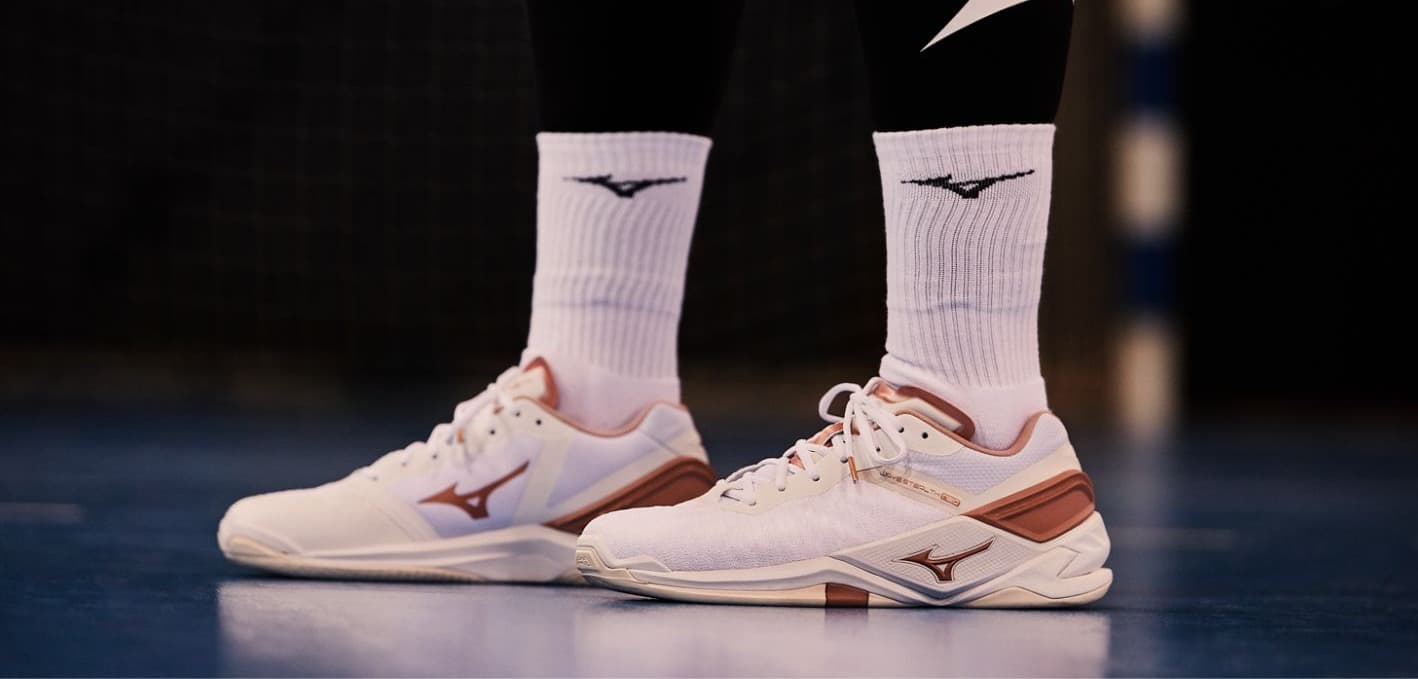
The Mizuno Wave Stealth Neo is the benchmark model for wings in the European elite. Mizuno's GUM8 outsole is the best grip compound on the market for parquet and synthetic surfaces: it offers a lateral adhesion that allows the sharpest changes of direction without losing traction. The Wave plate redistributes impact forces so that the energy return on every start is notable. And the whole package weighs little enough that wings do not feel any drag on long runs.
For advanced-level players with a tighter budget, the Asics Gel-Netburner Ballistic FF 3 is a very solid alternative. The double GEL system (heel and forefoot) offers excellent cushioning for landings on running shots, and the AHAR+ outsole has an exceptional durability that lets the shoe hold up well through a whole season of intensive use.
Shoes for goalkeepers: lateral zone and slide control
The goalkeeper is the most specific position in terms of shoe wear. The extreme lateral slides goalkeepers make generate concentrated wear on the outer part of the outsole that no other position experiences. On top of that comes the demand for cushioning in maximum-extension landings: when the goalkeeper throws himself sideways and lands on his hip and shoulder, the shoe absorbs part of that energy.
The Asics Gel-Netburner is the favourite of many elite goalkeepers precisely because of the combination of high cushioning and a durable outsole. Another model that works well for goalkeepers is the Adidas Stabil, which has a reinforced upper to withstand the repeated rubbing of goalkeeping. What a goalkeeper should avoid are shoes with a very low-profile outsole or soft rubber compounds: they hold up well for the first two months, but lateral wear makes them useless before the second half of the league season arrives.
For centre backs and backs: balance as the priority
Players in the outside back court (centre backs and backs) need shoes that give them a bit of everything: enough stability for jump shots and landings, enough traction for quick movements, and enough cushioning to get through long matches without suffering in the joints. There is no perfect shoe for this position because the position itself is the most versatile in handball.
The criterion I use with the centre backs and backs on my team is this: if you weigh more than 85 kg and play a physical game, prioritise stability and cushioning (you come closer to the pivot profile). If you weigh less than 80 kg and your game is more dynamic, prioritise traction and response (you come closer to the wing profile). That narrows the search significantly.
How to read the technical specifications of a handball shoe
When you read handball shoe product pages, the most relevant data points are, in order of importance for performance:
Outsole type: Rubber compounds specific to handball (Mizuno's GUM8, Adidas' high-grip rubber, Kempa's K-Rubber) offer better grip than generic indoor outsoles. Always look for the compound specification, not just "rubber outsole".
Cushioning system: BOOST (Adidas), Wave (Mizuno), GEL (Asics), K-Float (Kempa) are the most proven systems. Each has a different profile: BOOST prioritises energy return, Wave the redistribution of forces, GEL impact absorption. Depending on your position and playing profile, one will suit you better than the others.
Weight: In handball, shoe weight matters less than in athletics, but it is still relevant for positions that prioritise speed. A difference of 40-50 grams per shoe can be noticeable in long matches. For pivots, weight is secondary. For wings, every gram counts.
Fit: This is the hardest factor to assess without physically trying the shoe. Adidas has a wider forefoot last. Mizuno is relatively narrow. Asics sits in between. If you have a wide foot, this point is critical for comfort.
Playing level and training frequency: the economic criterion
There is no sense spending €150 on high-end shoes if you train once a week. And there is no sense saving €40 on shoes if you train four times a week and compete at national level. The wear of a handball shoe is directly proportional to the intensity and frequency of use, and high-end shoes are designed to withstand that intensive use without losing their properties.
My recommendation by level:
Beginner and amateur (1-2 training sessions/week): The Kempa Wing Lite 2 is the best value for money on the market in this segment. It costs around €65-80 and offers the minimum features needed to play with confidence on a handball court.
Intermediate level (3 training sessions/week, regional competition): The €80-120 range gives you access to the best intermediate models from all brands. The Kempa Attack Three Contender or the Asics Gel-Netburner in available sizes are excellent options.
Advanced and professional level (4+ training sessions/week, national competition or higher): From €120 upwards are the market benchmarks. Adidas Stabil Next Gen and Mizuno Wave Stealth Neo are the two options with the most backing in high-level handball. The investment is justified by their superior durability and the joint protection they offer in intensive use.
You can consult the complete Liftados handball shoe comparator to see the detailed files, up-to-date prices from all the shops and the technical analyses of each model. If you want a personalised recommendation based on your position and budget, the Liftados recommender gives you an answer in two minutes.
