This article contains affiliate links; if you buy through them, Liftados may earn a commission at no extra cost to you.
We have treated the figures as an economic investigation would: prioritising official documents, budgets, collective agreements and data published by the leagues. When a salary comes from the press or from a leak, it is identified as an estimate, not as confirmed contract data, and linked to the original source.
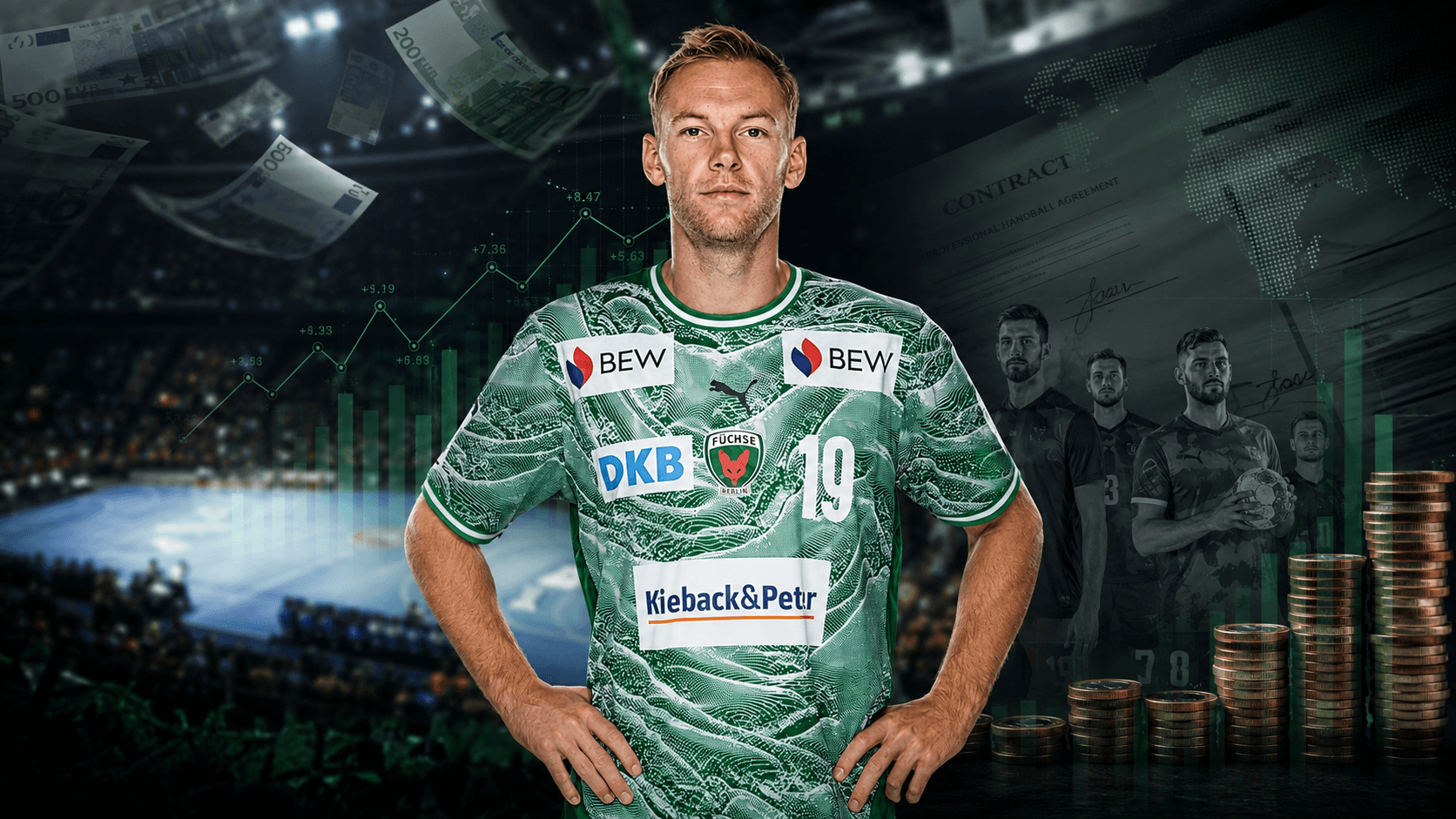
Mathias Gidsel is one of the most dominant athletes of his generation. Olympic champion, world champion, Bundesliga MVP and regarded as the best player on the planet, his new contract with Füchse Berlin is reportedly around €50,000 gross per month, compared with the €40,000 of his previous deal (Source: Kassel Lokal (se abre en otra pestaña)).
That is about €600,000 per season before bonuses.
It is an extraordinary amount within handball. But not within professional sport.
A relevant footballer in a major European league can earn that much in a week. Even the best-paid players in world handball remain very far from the figures of football, the NBA, the NFL or the EuroLeague.
The most important difference, however, is not the one separating Gidsel from the football stars. It is the one that exists within handball itself.
While a small elite can approach or exceed half a million euros a year, a considerable share of players in Europe's top divisions earn between €20,000 and €60,000 gross per season. In some championships, moreover, it is still common for athletes to combine handball with studies, jobs or parallel professional activities.
Men's handball does not have a single labour market. It has many.
Germany, France, Hungary, Poland, Denmark, Romania and some Middle Eastern clubs can offer very competitive salaries. Spain retains one of the championships with the greatest tradition and capacity to produce talent, but it can no longer compete economically with the big European powers except in the case of Barça.
That is why answering the question of how much a handball player earns requires distinguishing between countries, clubs, sporting hierarchies, taxation and contractual conditions.
A market without salary transparency
There is no global, audited database of handball players' contracts.
Most clubs do not publish individual salaries. Contracts usually include confidentiality clauses and part of the pay may arrive through bonuses, housing, a car, image rights or travel compensation.
There are also important differences in how figures are communicated.
A salary may be expressed as gross in Germany or France and as net in Poland, Hungary, Romania, Qatar or Saudi Arabia. Comparing the two directly leads to errors.
Nor does it mean the same to earn €5,000 gross per month in Paris, €5,000 net in Kielce or €5,000 together with housing and a car in Bucharest.
For that reason, the figures in this report should be read through three levels of reliability: official data (average, median and minimum salaries, budgets and payrolls published by leagues, public bodies or collective agreements), journalistic estimates (information attributed to club sources, agents or players' circles) and indicative ranges (bands built from budgets, testimonies, partial data and the usual structure of the market).
Not all figures have the same degree of certainty.
The salary pyramid of world handball
The economic structure of handball can be represented in five levels.
Scroll horizontally to see more →
| Player level | Indicative annual gross salary | Typical profile |
|---|
| World superstar | €500,000 - €900,000 | International benchmark of a Champions League contender |
| Champions League star | €250,000 - €500,000 | Starter in a powerful national team or a difference-maker |
| Established professional in a top league | €90,000 - €250,000 | Starter in the Bundesliga, Starligue or a big European club |
| Average professional | €35,000 - €90,000 | European top division, not a star |
| Entry-level or semi-professional | €15,000 - €35,000 | Young players, low-budget squads or small leagues |
These amounts do not work as a universal salary scale. They are an approximation of the international market.
An international player can earn less than €100,000 in Spain or Denmark and exceed €200,000 on moving to another country. Likewise, a rotation player at a German club can have better conditions than a star in a financially smaller competition.
Germany: the league that pays best most consistently
The German Bundesliga is the deepest market in men's handball.
It does not necessarily concentrate all the highest contracts in the world, but it does have the largest number of clubs able to pay good salaries to entire squads. THW Kiel, Füchse Berlin, SC Magdeburg, SG Flensburg-Handewitt, MT Melsungen, Rhein-Neckar Löwen and other projects have commercial structures, full arenas and a revenue-generating capacity far above that of most competitions.
A ranking of the ten best-paid German handball players places Andreas Wolff, Johannes Golla and Timo Kastening at the top of the German national team, with figures of between €30,000 and €42,000 per month at their respective moments in the market. These were press figures, not contracts published by the clubs (Source: Sports Illustrated Germany (se abre en otra pestaña)).
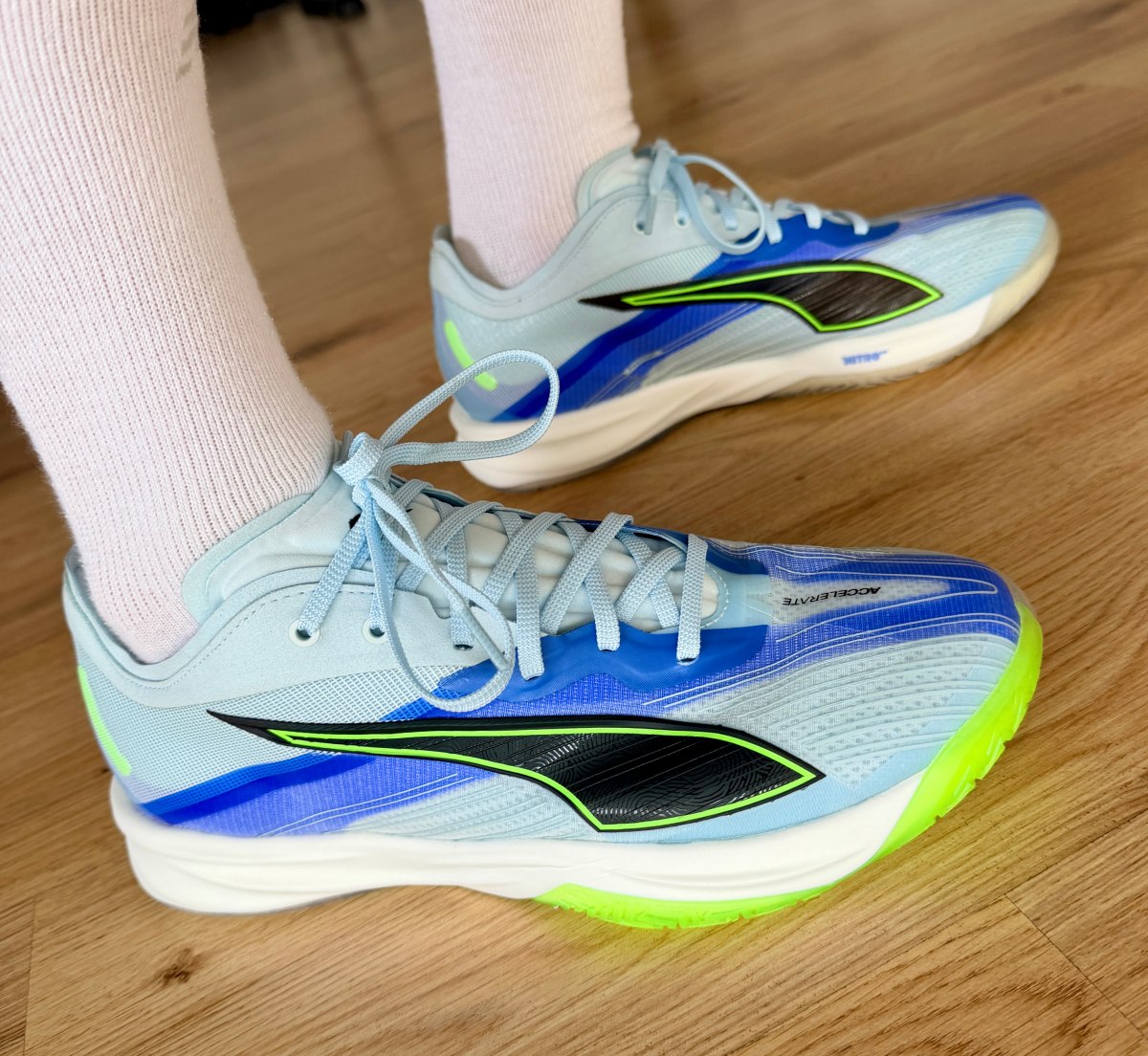
Mathias Gidsel plays in the Puma Accelerate Nitro SQD 5, the model that dominates much of the Bundesliga among wings, backs and centre backs — the same player profile that can end up signing the league's highest contracts.
Andreas Wolff also moves at that level. During his time at Kielce, estimates of up to €40,000 net per month were published. His return to THW Kiel in 2024 also involved a deal with a compensation fee estimated at €600,000 for his former club, an unusual figure in handball (Source: Handball-World.News (se abre en otra pestaña)).
For the new cycle, various German reports put Johannes Golla at about €580,000 a year and indicated that his move to MT Melsungen from 2026 could bring him close to €720,000, which would make him the best-paid German player ahead of Wolff. Again, these are press estimates (Source: t-online.de (se abre en otra pestaña)).
In the Bundesliga, therefore, stars can move roughly between €300,000 and €700,000 gross a year. Established starters at important clubs usually fall below that level, but can reach between €150,000 and €300,000.
In the middle and lower part of the competition, the reality changes. Salaries of young players, defensive specialists or members of lower-budget squads can lie between €50,000 and €120,000.
The great German advantage lies not only in the salary ceiling. It lies in the floor and in the number of reasonably well-paid jobs. A player does not need to be a world superstar to live exclusively from handball.
France: the championship that best explains the difference between mean and median
France is the country that offers the most precise economic information.
The Ligue Nationale de Handball publishes aggregate data on budgets, payrolls and pay. For the 2025-2026 season, the average fixed salary of a Starligue player was €6,261 gross per month, 3% less than the previous season. The median salary stood at €5,000 (Source: HandNews, based on LNH data (se abre en otra pestaña)).
The difference is important. The mean is influenced by the highest contracts. The median indicates that half of the players earn less than €5,000 gross per month and the other half earn more. The figures exclude bonuses and benefits in kind.
The average fixed pay would have fallen compared with the previous season. This suggests that budget growth does not automatically translate into contracts and that several clubs are trying to contain labour costs.
With twelve monthly payments, the average salary equals about €75,132 gross per year. The median is around €60,000.
But the gap between clubs is enormous. The average Starligue budget for 2025-2026 was around €5.83 million, also down on the previous year. The median was €4.6 million. Paris Saint-Germain declared a budget of €17 million, Nantes exceeded €11.1 million and Montpellier reached approximately €9.07 million.
The average payroll of a Starligue club is around €2.36 million, about 40% of the total budget. Clubs devote a considerable part of their budget to salaries, contributions and recruitment costs.
This creates several markets within the same league. At PSG, Nantes or Montpellier, an international star can comfortably exceed €200,000 a year. At modest clubs, many players are closer to €35,000-60,000.
France shows why it is misleading to simply say that "a top-division player earns €6,261 a month". That amount represents a statistical average, not the payslip of the typical player at every team.
Spain: a professional league with very unequal salaries
The Liga ASOBAL has professional status. That does not mean all its clubs have an economy comparable to the Bundesliga or the Starligue.
The V Collective Agreement for professional handball, registered by the Directorate-General of Labour and published in July 2024, established that players' minimum salary must correspond to the prevailing national minimum wage (SMI). Pay may include monthly salary, extra payments, signing bonus, match bonuses, incentives and image rights (Source: BOE — V Collective Agreement for professional handball (se abre en otra pestaña)).
This reference is revealing. A professional league in which the agreed floor coincides with the SMI acknowledges that part of the championship operates very close to the economic limit of professionalisation.
There is no official average salary published for the whole ASOBAL. Nor is there a homogeneous payroll. Club budgets show enormous differences.
Barça is an exception. It competes economically with the European elite, although the club's overall financial situation has forced adjustments to the professional sections too: for the 2025-2026 season, the club allocated €56 million to the combined payroll of its sections, of which €7.5 million went to handball, while basketball was the only section to see its investment cut because of LaLiga's financial control (Source: Última Hora (se abre en otra pestaña)).
Then comes a group of strong projects, such as Granollers, Bidasoa, Logroño or Ademar, but with an economic capacity clearly below that of Barça and of the German, French or Hungarian contenders.
Bidasoa Irún, for example, had a total budget of around €1.9 million in the 2024-2025 season, after growing 30% to €1.5 million two years earlier. These are club budget figures, not individual payroll, but they confirm that even a consolidated European project like the Irun side operates very far from the big Central European clubs (Source: Noticias de Gipuzkoa (se abre en otra pestaña); 2Playbook (se abre en otra pestaña)).
For 2026-2027, CB Villa de Aranda approved at its members' assembly the highest budget in its history: €1,350,000, €250,000 more than the previous season, thanks to the push of sponsors, fans and public administrations. Not all of that money goes to the first squad: it also funds structure, travel, youth development, staff and organisation (Source: Balonmano Villa de Aranda (se abre en otra pestaña)).
From the available budgets and the structure of the clubs, a prudent range can be set:
- Young players and players with little weight in the rotation: around the SMI or between €20,000 and €30,000 gross per year.
- Established professionals at modest clubs: between €30,000 and €55,000.
- Starters at European or international teams: between €55,000 and €100,000.
- Stars of the strongest projects: between €100,000 and €180,000.
- Barça stars: clearly above, with contracts potentially in the salary zone of the big European clubs.
These bands are not an official table. They are a reasoned reconstruction of the market.
In Spain the non-salary package also carries a lot of weight. Housing, a car, meals, a job for the partner, study grants or club-linked jobs can substantially change the real value of an offer. A €35,000 contract with housing included can be more attractive than a €42,000 one in an expensive city with no help at all.
Hungary: Veszprém and the power of a great project
Hungary has a very concentrated league. Veszprém is one of the clubs with the greatest economic capacity in the world. Pick Szeged also maintains a strong project, but the distance from the rest of the championship is considerable.
The best proof of Veszprém's financial muscle is usually sought in its transfer dealings, although they should be treated with caution. In 2025 several outlets put the transfer of Ivan Martinovic at about €850,000 and that of Mikael Appelgren at €150,000. The Hungarian club itself later came out to deny those figures: according to its sporting management, the real cost of the Martinovic signing was far below that amount —under half a million euros— and Appelgren cost nothing, as it was a direct swap with Rhein-Neckar Löwen for Mike Jensen (Source: mibalonmano.com (se abre en otra pestaña)). The episode is a good example of why transfer and salary figures in handball always require a second check.
A world-class starter at Veszprém can still receive a contract comparable to or higher than those of the big stars in Germany. In certain cases, the net salary, housing and bonuses can place the total value of the package at the top of the European market.
The lack of official publications prevents building a reliable average for the Hungarian league. Veszprém's reality cannot be extrapolated to all clubs either. Hungary is another example of a championship with a very rich top and a much more modest base.
Poland: two giants and a market conditioned by its stability
For years, Kielce and Wisła Płock have been able to attract elite players.
The figures circulated about Andreas Wolff during his time at Kielce ranged between €42,000 gross per month and €40,000 net, depending on the publication. That divergence shows how hard it is to compare salary leaks without knowing the contractual structure.
Specialist Polish sources place standout players at Kielce or Płock between 15,000 and 50,000 zlotys gross per month, with the highest contracts reserved for figures such as Alex Dujshebaev, and entry-level salaries of between 2,000 and 5,000 zlotys for young players and debutants. These are indicative, unaudited figures (Source: SW7 Sports (se abre en otra pestaña)).
Poland can pay top-level salaries at its two big clubs, but the financial risk has historically been higher. Changes of sponsor, late payments or restructurings affect projects that depend on one or two big backers much more. For a player, the promised salary is not the only criterion. The guarantee of being paid also matters.
Denmark: a huge amount of talent and more modest salaries
Denmark dominates international handball, but its league is not the one that pays the most.
The country produces coaches, players and development systems of the highest level. Yet many of its best internationals end up competing in Germany, France or Hungary.
The Danish players' association (Håndboldspiller) structures its membership fees according to different salary bands, and includes a specific category for contracts above 500,001 Danish kroner a year, about €67,000. This confirms the existence of professional players with significant pay, although it does not allow the average for the whole competition to be calculated (Source: Håndboldspiller — fee table (se abre en otra pestaña)).
In the Herreliga, a star can earn a comfortable salary as a professional, but the big German contracts remain far more attractive. A reasonable range for a good part of the professionals would be between €35,000 and €90,000 gross per year, with higher amounts at Aalborg, GOG or other important teams.
Denmark works as a development market and a shop window. Germany frequently acts as the buyer of already established talent.
Romania: good contracts with public money and big differences
Romania has increased its presence in the international market. Dinamo București has assembled squads competitive in Europe and has signed players from Spain, France, Portugal or the Balkans.
An analysis published by We Love Sport on the men's Liga Națională describes budgets and salaries as a taboo subject in Romania, in contrast to the transparency of France, where most Starligue players move between €4,000 and €6,000 gross per month as a comparative reference. The Romanian figure should be read with caution because it does not represent an official statistic for the whole competition (Source: We Love Sport (welovesport.ro) (se abre en otra pestaña)).
The Romanian model has a particularity. Some clubs depend considerably on administrations, public structures or multi-sport entities. That can generate attractive contracts, but also recurring debates about sustainability, budget priorities and institutional dependence.
Benefits in kind are once again decisive. A foreign player can negotiate housing, a car, flights and bonuses. The net value of the contract can be higher than the monthly salary suggests.
Sweden, Norway, Switzerland and other European markets
Northern Europe produces much more talent than it can retain.
Sweden and Norway have leagues that are competitive from a sporting point of view, but many players do not earn salaries comparable to those in Germany or France. In the middle and lower tiers it is still possible to find semi-professional contracts, and a good part of the squad combines handball with studies or work (Source: Handbollskanalen (se abre en otra pestaña)). Only the Swedish internationals who export their careers to Germany or France come close to the big contracts: the national team's average salary has been estimated at about 678,000 kronor a year, far above the domestic league average (Source: Idrottens Affärer (se abre en otra pestaña)).
Switzerland has well-organised clubs, such as Kadetten Schaffhausen, but a small market. Salaries can be reasonable for its stars, especially with accommodation or complementary employment, although the Swiss cost of living reduces the real advantage.
Portugal has also grown thanks to Sporting, Benfica and Porto. All three can offer competitive European contracts to certain players, but salary capacity clearly diminishes outside that group.
In the Balkans, the technical level remains high. The capacity to pay stable salaries is much more irregular. Serbia, Croatia, Bosnia, North Macedonia or Slovenia produce players for the richest leagues, but their domestic competitions find it hard to retain them.
Qatar, Saudi Arabia and the market of net contracts
The Middle East works in a different way.
Qatar, Saudi Arabia, the United Arab Emirates and, in some cases, Kuwait or Bahrain can offer short-term contracts, net packages and tax advantages that are hard to match in Europe. There is no public, stable salary scale. Conditions depend on the club, the player, the tournament and whether it is an annual contract or a one-off reinforcement.
In 2025 it emerged that Mohamed Amine Darmoul, then at MT Melsungen, had received three offers from Middle Eastern clubs —Al Ahly of Egypt, Al Rayyan of Qatar and Khaleej of Saudi Arabia— to sign a three-season contract with pay far above what the Bundesliga could offer him. Darmoul turned them all down to sign for TVB Stuttgart and stay in Germany (Source: Fitness Volt (se abre en otra pestaña)).
This kind of offer does not represent the usual salary of the local player or of all foreigners. It corresponds to a highly valued international profile. Temporary contracts for specific championships are also frequent. A player can receive in a few weeks an amount similar to several months of European salary.
The comparison must always be made in net terms and taking associated benefits into account. Housing, flights, a car, bonuses and taxation can practically double the real appeal of a proposal.
The best-paid players in the world
It is not possible to publish a definitive ranking without access to the contracts. The top salary group can, however, be identified from consistent information.
Mathias Gidsel is reportedly on around €600,000 gross a year with Füchse Berlin. Andreas Wolff has reportedly moved in recent years between €500,000 and €600,000 a year, with some reports describing his Polish contract in net figures. Johannes Golla could approach €720,000 a year in his new contract cycle with MT Melsungen, according to the estimates already cited.
The big stars of Veszprém, Barça, PSG, Nantes, Kiel, Magdeburg or Melsungen may occupy a similar zone. Some Middle Eastern contracts may exceed those figures in net terms.
The ordinary ceiling of the world market therefore appears to lie roughly between €600,000 and €900,000 a year. There may be exceptions above a million, especially when adding bonuses, image rights or special contracts, but there is not enough public evidence to claim they are common.
The amounts of around €90,000-125,000 per month that circulated during the time of Nikola Karabatic and Mikkel Hansen at PSG —Karabatic himself has acknowledged figures of more than €1.7 million a year adding salary and sponsorships— belonged to an exceptional era and project (Source: HandNews (se abre en otra pestaña)). They were press estimates, not a general scale of the market.
Salary is not the player's total cost
When a club says it devotes a million euros to its squad, that does not mean the players split a million in net salaries.
The staff budget may include:
- Gross salaries.
- Social security contributions.
- Bonuses.
- Housing and cars.
- Agents' commissions.
- Compensation payments.
- Signing costs.
- Insurance.
- Medical services.
- Image rights.
- Tax costs arising from foreign players.
In France, the LNH separates staff costs from other recruitment expenses. In Spain, the known accounts of some clubs also show that contributions can add a very significant amount to the direct salary.
A player who receives €70,000 gross can represent a clearly higher cost to the club. That is why it is also incorrect to divide a team's total budget by the number of players to calculate the average salary.
Bonuses, housing and image rights
The fixed contract is only one part of the pay.
Bonuses can be paid for European qualification, titles, wins, staying up, matches played, goals, call-ups or collective performance.
In France, the regulations establish that bonuses related to participation or sporting results must be paid before the end of the corresponding season. It also recognises that fixed pay may include benefits in kind valued in the contract.
In Spain, the agreement expressly provides for monthly salary, extra payments, signing bonus, special bonuses, match bonuses and image rights (Source: BOE (se abre en otra pestaña)).
For players who change country, housing is especially important. There may also be a car, plane tickets for the family, school for the children, private insurance or help with taxation. Two contracts with the same gross salary can have very different real values.
A short career with little margin for error
Handball salaries must be analysed taking career length into account.
A player can reach the first team between the ages of 19 and 23. His best contractual period is usually concentrated between 25 and 32. Injuries, competition and coaching changes can shorten that window.
Most do not sign guaranteed five- or six-season contracts. One-, two- or three-year deals are the norm.
A professional who earns €60,000 gross a year for eight seasons is not financially set for life. He needs to pay contributions, save, study and prepare a second career.
Moreover, the physical risk is high. The calendar includes league, cup, European competition and the national team. A serious injury can immediately affect the next contract.
That is why a salary that seems high compared with a worker's average pay must be weighed against the short professional life and the lack of long-term guarantees.
Why Germany pays more
A player's salary does not depend only on his quality. It depends on the revenue the ecosystem generates.
The Bundesliga has better attendances, arenas with greater commercial exploitation, sponsors, broadcasting rights, hospitality and a broader business base.
France combines private investment, corporate sponsorship and public support. The average Starligue budget is close to €5.83 million, albeit with strong inequality between clubs.
Spain has tradition, youth development and a following, but lower commercial revenue. Many clubs depend on local sponsors and subsidies. When a main backer disappears, the whole squad is affected.
Salary is the end result of that economic difference. Having good players is not enough. A competition has to be built that can generate money on a recurring basis.
The real pay of professional handball
The public image of the elite athlete can suggest that all professional players enjoy extraordinary contracts.
That is not so.
The summit of world handball lives very well. A small group earns between half a million and close to a million euros per season. They are the Gidsels, Wolffs, Gollas and other stars of the richest clubs.
The next band, made up of internationals and Champions League starters, can move between €150,000 and €400,000.
But most professionals are far from those amounts.
In France, the official median salary is €5,000 gross a month. In Spain, many contracts lie between the SMI and €50,000 a year. In Denmark, Sweden, Portugal or the Balkans there are players who combine sport with studies or jobs. Outside the European elite, semi-professionalism remains a structural part of the system.
The conclusion is uncomfortable, but necessary.
Handball is fully professional in its physical, tactical and personal demands. It is not always so in its pay.
Players train like elite athletes. They travel like professionals. They get injured like professionals. They compete under international pressure. Yet a significant share earn salaries typical of an industry that has still not managed to monetise all the attention, emotion and sporting value it produces.
The great challenge of handball is not just to manufacture new stars. It is to build an economy that allows those who play below them to live decently.
Sources and methodology
This report uses official data from the French Ligue Nationale de Handball, the Boletín Oficial del Estado and the Liga ASOBAL, budgets published by clubs (Villa de Aranda, Bidasoa) and journalistic estimates from specialist media in Germany (Sports Illustrated Germany, t-online.de, Handball-World.News, Kassel Lokal, Flashscore), France (HandNews), Spain (Última Hora, Noticias de Gipuzkoa, 2Playbook, mibalonmano.com), Poland (SW7 Sports), Denmark (Håndboldspiller), Romania (We Love Sport), Sweden (Handbollskanalen, Idrottens Affärer) and the Middle East (Fitness Volt). Each unofficial figure links directly to the original publication.
Individual amounts not published by the clubs are presented as estimates. The ranges by championship are editorial approximations built from known salaries, budgets, staff payrolls, collective agreements and the economic structure of the leagues. They should not be read as official contract tables.