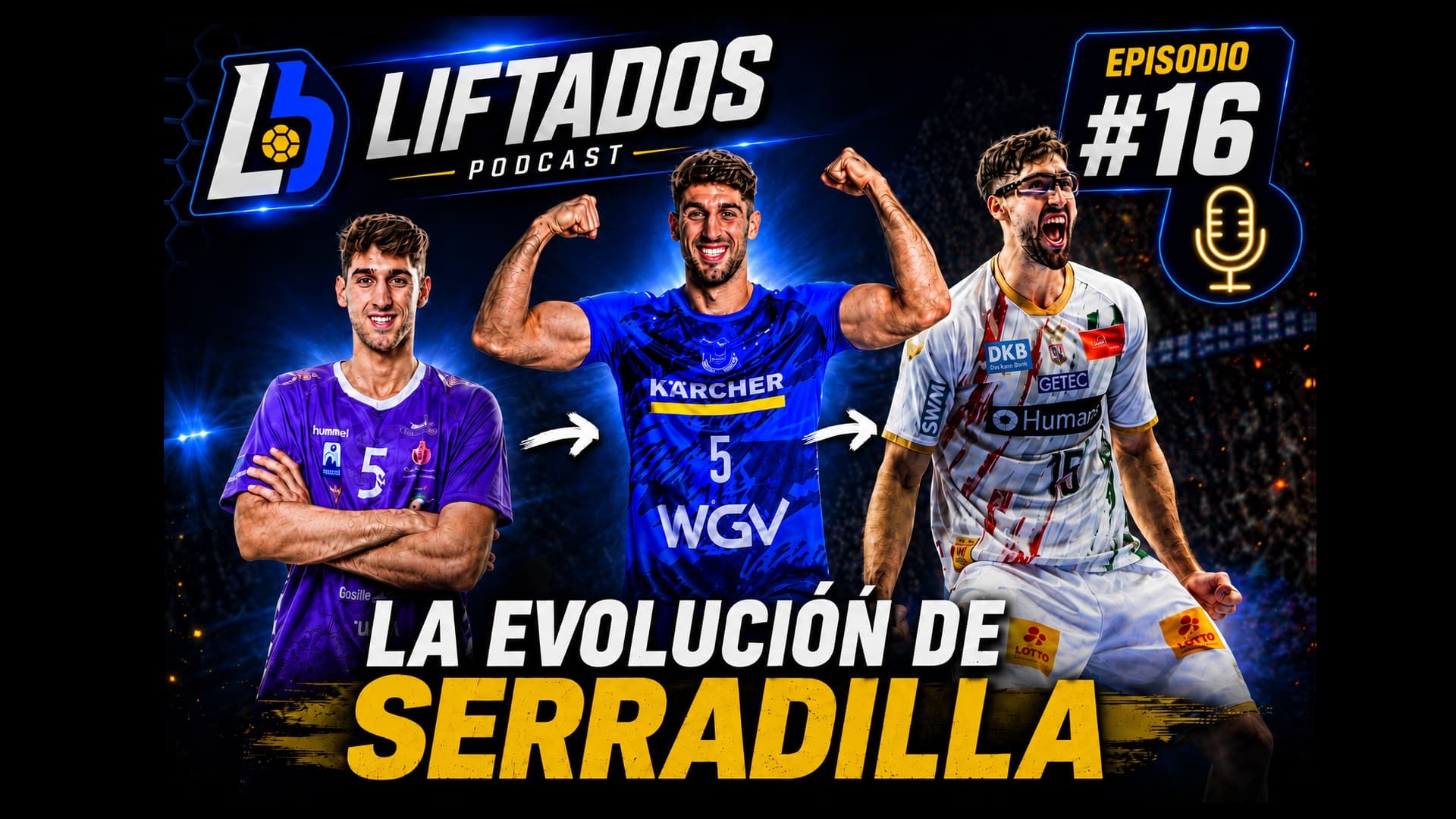

You can now enjoy the full episode of Liftados with Antonio Serradilla, one of those players who explain on their own why elite handball still has something irreducibly special about it. The sound set, this time improvised with total honesty in the now-classic ball room, welcomed the Dos Hermanas academy graduate, currently at Stuttgart, a Spain international with the Hispanos and the protagonist of one of the juiciest inside stories of the recent European market.
The conversation covers all sorts: almost obsessive recovery methods, nicknames from the youth categories, confidences about his time in Norway, memories of Montequinto and a return to the ecosystem of European champions Magdeburg that has a lot more to it than it seems from the outside.
Antonio Serradilla on Liftados: episode available now
The full conversation with Antonio Serradilla is now available. It will be one of those episodes that work because of the character and because of the content: a top-level defender, with an already proven career in the Bundesliga and with the Spanish national team, opening up without too many filters about how he lives, how he competes and how he looks after himself.
There is plenty of handball in the interview, of course, but personality too. Serradilla does not sound like a prefabricated player. He drops anecdotes, admits to quirks, laughs at himself and explains quite naturally why some teammates look at him as if he were a bit mad when he starts his recovery rituals.
The "Llorente of handball": biohacking, red glasses and serious recovery
During the show a nickname comes up that sums up the tone of the episode quite well: the "Llorente of handball". Serradilla takes it with humour, but behind the joke there is real substance. The defender looks after his recovery with a discipline that is unusual even at the elite level. In a league as physical as the Bundesliga, for him it is not posturing: it is competitive survival.
"On the team a lot of them laugh at me and joke about me, they think I'm crazy, but I have personality and I don't mind", he admits during the chat. And he elaborates with concrete examples: pressotherapy boots, specific routines before sleeping and eye-catching red-light glasses to prepare for rest.
His explanation makes quite a lot of sense to anyone who has lived through a season packed with matches: "Red light simulates sunset, raises melatonin and gives the body that drowsy feeling you get after eating. It helps me a huge amount to recover". In a sport where every Monday you start half broken, details like that make a difference.
From "Galápago" to inline figure skater
One of the funniest moments of the episode comes when the nickname that Isidoro Martínez gave him in the lower categories appears: "El Galápago". Serradilla recalls with a laugh that they called him that because he lived on the floor, drawing fouls in attack and exaggerating just enough to gain an advantage. A specialist in the craft even before turning professional.
But there is another story that is even better. Behind his almost two metres of height, his profile as a hard defensive centre back and that image of a human wall, an unexpected past appears: Antonio Serradilla did inline figure skating. Not just as a summer game, but at a certain level, to the point of performing figures and jumps with ease.
The inside story also has a lovely family touch: his mother was the teacher. Serradilla admits that he still feels a bit embarrassed talking about it, but that is precisely why it works so well in the episode. Because it dismantles the caricature of the elite defender and shows a player far more distinctive than the cliché would let you imagine.
Montequinto, Dos Hermanas and the explanation of an academy that keeps producing talent
When the conversation turns to grassroots handball, the episode gains a lot of value for anyone who follows Spanish youth development. Serradilla speaks with pride of Montequinto as one of the academies that best explain neighbourhood handball. His reading does not rely on big resources or empty speeches: he talks about coaches putting in hours for love of the game, travelling whatever was needed and building something almost artisanal.
That neighbourhood pride comes up again and again. There was no money, he recalls, but there was a very strong sense of belonging. Several good generations, committed coaches and an ecosystem where handball was not seen as a mere pastime. It was seen as something serious, even before anyone thought of leaving there for the European elite.
That stretch of the episode connects very well with one of the most interesting ideas Liftados has been working on in the Magazine: Spanish talent does not appear by accident. It is cooked up in clubs where there are still people willing to sustain training sessions, trips and whole weekends simply because they believe in this.
The journey to the elite: Logroño, Elverum, Stuttgart and the Magdeburg case
Serradilla's career is also worth pausing on. From his youth years to the leap into professionalism, his career has had important stops: Logroño, the experience in Elverum and consolidation in Germany. About Norway he offers a line that sums up what that stage was quite well: a unique experience, with good and bad moments, but decisive in his growth.
Then came the Bundesliga and, with it, the big recent plot twist. At Christmas, because of the lack of minutes in the first half of the season with Magdeburg, Serradilla made a logical career decision: to sign for two years with Stuttgart to ensure continuity. It looked like a stability move. Then everything changed.
Injuries at Magdeburg opened up a huge space for him in the second part of the season. He started playing, performed, became important and ended up a useful piece within the context of the European champions. Then the German club's regret appeared, and they decided to bring him back by paying his release clause to Stuttgart. A move with quite the air of a big club that realises too late it has let go a player it did want to keep.
In the episode, Serradilla sums it up with a memorable line: Magdeburg's "Florentino" said that he was coming back. He tells it with humour, but also with understandable satisfaction. Because beyond the contractual inside story, there is a strong message: one of the best clubs in the world has considered it worthwhile to pay to have him back.
A very Liftados episode: laughs, odd details and plenty of real handball
The best thing about this chat is that it does not stop at isolated headlines. It has that Liftados tone that works when the guest truly gets into the game: dressing-room stories, unconventional methods, grassroots handball, the European elite and that mix of seriousness and banter that usually makes the best episodes.
For anyone who follows the Spanish national team, the Bundesliga or simply enjoys players who have something to say, it is worth making room. You can now enjoy the full episode with Antonio Serradilla on YouTube and on all podcast platforms.
Available now
Full episode · Antonio Serradilla
The full conversation with Antonio Serradilla is now available. You can enjoy this Liftados episode on your favourite platform:
