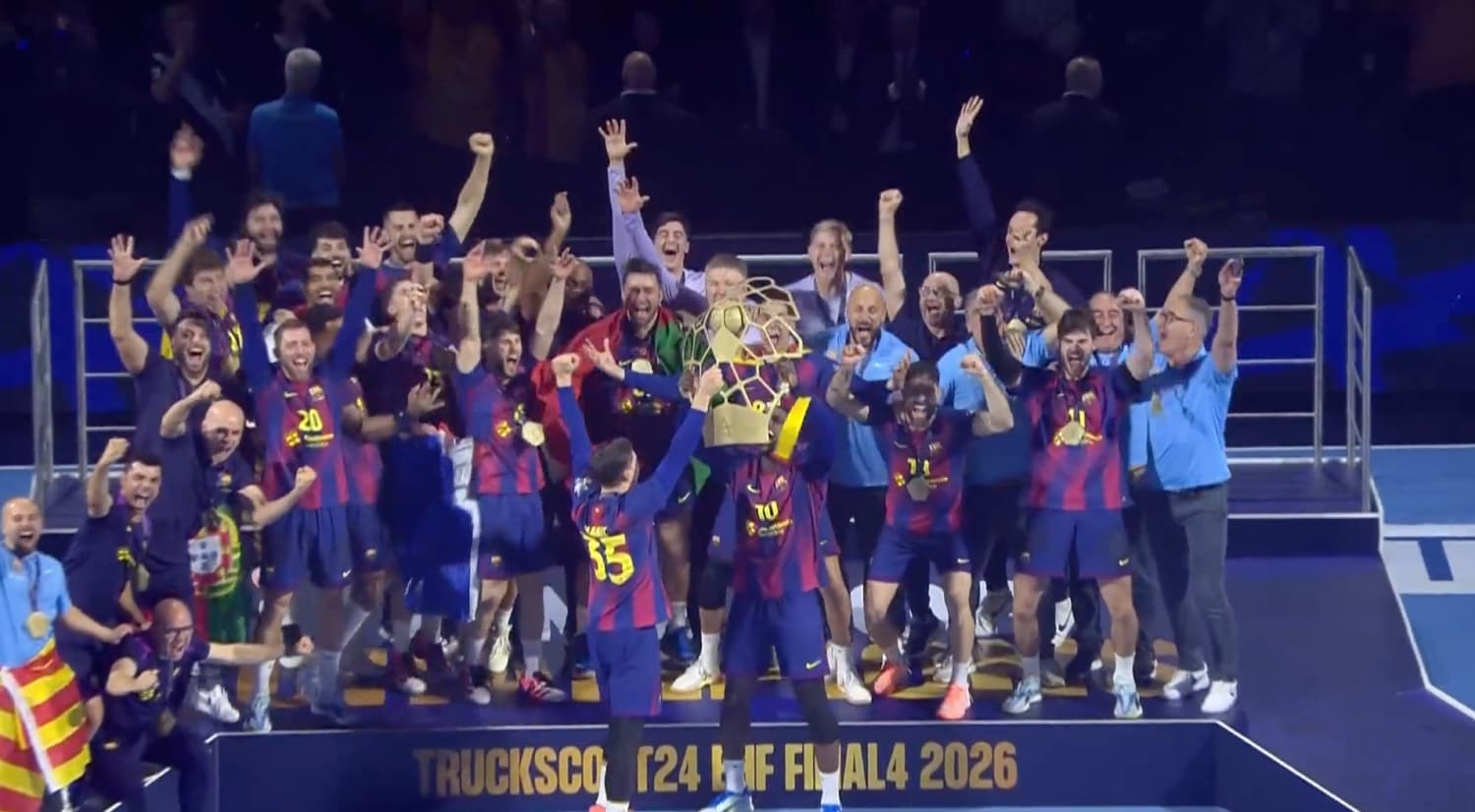
Cologne has its owner. FC Barcelona lifted the thirteenth Champions League in its history yesterday, Sunday, with a performance that left no room for doubt: 37-34 against a Füchse Berlin that arrived hungry, energetic and with the best season in its history, and found a team that knows exactly how to win this. The LANXESS Arena watched the Blaugrana build the victory brick by brick, hold firm when Berlin threatened to cut the lead, and close out the match without letting the tension turn into real danger.
Two matches, two wins. Barça left Cologne without having lost a single set. And Carlos Ortega becomes the coach with the most European titles in the history of club handball.
The final Berlin couldn't break
Füchse Berlin came into the final with the momentum of those who had done the hardest part: knocking out the defending champion the day before. The semi-final against Magdeburg had given them rhythm, confidence and an inertia that carries enormous weight in handball. The LANXESS Arena expected an open, high-speed match, with Mathias Gidsel distributing play and the Berlin side trying to turn the final into a sprint race in which physical and mental fatigue would become the deciding factor.
Barça read exactly that script. And defused it.
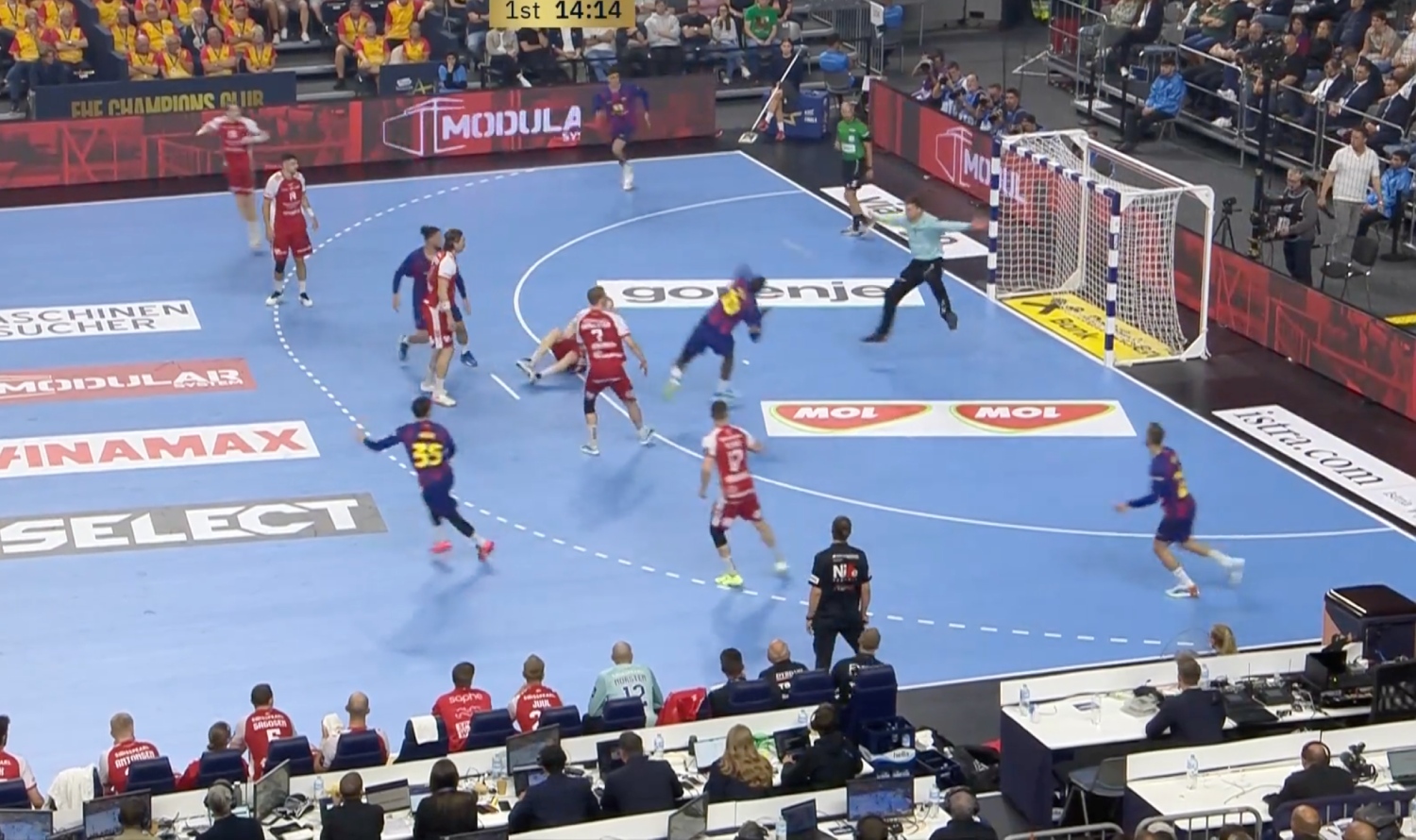
The match started level: 2-2 in the opening minutes. That was the only moment of real balance. From there, the Blaugrana added goals methodically, giving up no space in transition, building from the back with Emil Nielsen as the first shield and managing the tempo of the match with a coolness that by now is almost a hallmark of Ortega's team.
The statistic that best sums up Berlin's first half: Mathias Gidsel, the man who had scored 144 goals in the regular season —the record for a single edition of the Champions League— did not score until the 25th minute. By then, Barça were already winning by five goals. What should have been Füchse's most dangerous piece was neutralised throughout the first half by a combination of collective defence, positional reading and the constant pressure that the Blaugrana 5:1 exerted on Berlin's build-up.
The break arrived with a 20-16 in Barça's favour. A margin that, against Berlin, was not comfortable. But enough to work from a position of calm.
Berlin squeeze, Barça don't yield
The second half was different. Füchse came out of the break with a different disposition. Gidsel began to find space, Berlin's defence adjusted, and the team began to function more like the team that had fascinated throughout the season. The five- and six-goal gaps Barça had built began to shrink.
At the most dangerous moment of the match for Barcelona, the score reached 33-31. Two goals. Füchse smelled blood. The LANXESS Arena roared. And then Barça appeared.
Not the nervous Barça that in the semi-final had seen Aalborg drag them into extra time. The cold Barça. The one that knows that in these moments you don't accelerate, you control. Nielsen made a key save under the posts at the moment of maximum pressure. Blaž Janc scored a goal of more merit than it seems. Domen Makuc was relentless from the six-metre line. And the lead opened up again.
The final 37-34 doesn't fully reflect the real difference in level between the two teams in the decisive moments. Berlin tried everything —including two red cards that complicated things even further— but Barça never let them believe they could win this match.
The thirteenth title of a story that goes on
Carlos Ortega collects his ninth European title as a club coach. It is the all-time record in the competition. And he does so with a team that could have justified a defeat in Cologne —they reached the FINAL4 after a semi-final that went to extra time— and yet came out onto the court with a clarity of ideas that makes everything look easy when it isn't.
Emil Nielsen was decisive. In the moments when the match threatened to get complicated, the Danish goalkeeper appeared with the solidity of someone who knows exactly what he is doing. The final numbers don't reflect everything he contributed: it was the saves at the right moments, not the quantity, that made the difference.
Janc, Makuc and Luís Frade on the six-metre line kept the team in its most comfortable attacking position. And a Barça that never gave up its structure, that didn't try to be faster than the match needed and that carried out Ortega's plan with the precision of someone who has done this many times, reaped what it had sown.
Füchse Berlin can leave Cologne with their heads held high. Their season has been extraordinary. Gidsel closed the year as the greatest scorer in history in a single season. The semi-final against Magdeburg was one of the most intense matches of recent FINAL4s. And the Berlin project now has the certainty that it can fight for this.
But today Cologne is Blaugrana. The LANXESS Arena saw the best team in Europe lift the trophy. And European handball can get ready to keep debating whether anyone will be able to take this away from Barça.

Director · Liftados
Barça didn't win the final in the 60th minute. They won it in the first twenty-five.
What impressed me most about this final is not the result, nor Barcelona's level over the 60 minutes. It is what Barça did with Mathias Gidsel in the first half. The best scorer in Champions League history in a single season —144 goals in the regular league— didn't score until the 25th minute, when the match was already broken. It was no coincidence. It was a defensive plan executed to perfection.
Barça didn't try to stop Gidsel individually. That doesn't work. What they did was cut the balls before they reached his hands: the 5:1 pressing Berlin's build-up, Nielsen commanding the goal, the defence with no unnecessary help. And when Gidsel finally received the ball with space, they were already five down. In that context it is much harder to be Gidsel than when the match is open.
Berlin tried in the second half. They got to within two goals. And there Nielsen appeared again. And Janc. And Makuc. That is what teams that have won this thirteen times have: they know exactly what to do when the match tightens.
Füchse Berlin deserve enormous credit. They have had a historic season. But European handball has a problem: as long as Barça keep having Ortega, Nielsen and that ability not to break at the key moments, it will be very hard to take the title from them.
Cologne 2026 has been a FINAL4 to remember. Two epic matches on Saturday, a final that promised more excitement than there ended up being. The champion was one from start to finish. And that, sometimes, is the hardest thing for the opponent to accept.
