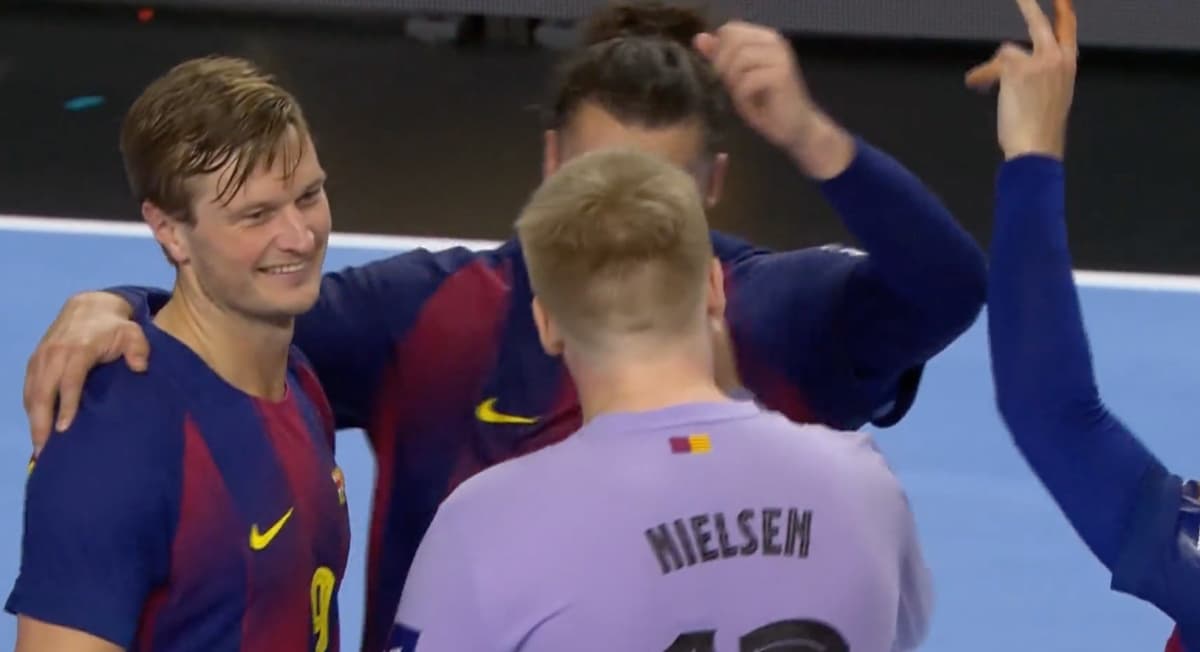

On 13 August 2026, the ASOBAL League launched ASOBAL TV, its first own audiovisual platform. For the first time in the history of Spanish handball, the 240 matches of a full season (the fourteen teams of the top category, every round) can be watched in a single place, managed directly by the league itself (Source: ASOBAL (se abre en otra pestaña)).
The entry price is low: €5.99 a month or €49.99 a year, although until 10 September 2026 the annual plan can be taken out for €29.99. To benefit from this promotion you will need to enter the launch code ASOBALTV2627. Club season-ticket holders also get a reduced rate of €23.99 with an exclusive code per club.
Subscription is now open on ASOBAL TV (se abre en otra pestaña), hosted on StreamWay+, HiWay Media's OTT platform. For now it works from the web; the Android and iOS apps, and the option to watch on the TV via Chromecast and AirPlay, will arrive in the coming weeks.
It is good news for the fan. But behind ASOBAL TV there is a much more uncomfortable question, one that has been running through every handball league in Europe for years: who should control the screen? The competition itself, a big commercial operator, a public channel, or a split of territories? There is no single answer. Every major European league has chosen a different path, and every path has a price.
Why ASOBAL TV was born: the story starts with a closure, not with a plan
ASOBAL TV is not, at its origin, a strategic decision taken calmly. It is an emergency response.
Since 2023, the ASOBAL League had signed an agreement with LaLiga+, LaLiga's multisport platform formerly called LaLigaSportsTV, which was to cover Spanish handball broadcasts until the 2027-2028 season. LaLiga+ was born with a vocation different from that of a business in itself: to give audiovisual visibility to federations and competitions that otherwise would have no room on television. Over seven years it came to cover more than 45 sports federations, with a technological investment that exceeded 10 million euros (Source: 2Playbook (se abre en otra pestaña)).
But LaLiga decided to close that platform on 30 June 2026, three seasons earlier than agreed with ASOBAL, claiming it had fulfilled its initial purpose. The closure suddenly left in the dark competitions such as ASOBAL itself or football's Primera RFEF, which depended on LaLiga+ as their main showcase (Source: ADSLZone (se abre en otra pestaña)).
Before LaLiga+, the ASOBAL League had already relied on the free-to-air formula: in 2018, under the presidency of Adolfo Aragonés, the league signed an agreement with the then LFP of football to broadcast four matches per round free to air: one on Gol de la TDT and three by streaming through the Liga TV app. Aragonés then defended an idea that remains the central argument of this whole debate: that free-to-air visibility increases the value of sponsorships and of the players themselves (Source: IUSPORT (se abre en otra pestaña)).
With the closure of LaLiga+ already announced, ASOBAL activated a contingency plan: it launched a tender to find a technology company to develop its own digital infrastructure, with a model that combines subscription (SVOD) and pay-per-view (PPV), as well as contemplating the resale of the signal to national and international telecommunications operators and audiovisual platforms (Source: Roams (se abre en otra pestaña)).
That last point has already begun to move: ASOBAL closed an agreement with Sportradar for the commercialisation and international distribution of its audiovisual rights and its official match data, with the aim of gaining visibility among operators, platforms and fans in other countries (Source: 2Playbook (se abre en otra pestaña)).
ASOBAL TV, in short, is not born of excess ambition. It is born of the need not to disappear from the screen. And that need is shared, to a greater or lesser degree, by almost all handball leagues on the continent.
European handball has no single model
There is no standard formula for broadcasting handball in Europe. At least four different models coexist, and each responds to a different economic logic:
- The federation's or league's own platform, alone or combined with a paying partner (the model of HandballTV in France, and now of ASOBAL TV in Spain).
- Sale to a pay sports-streaming specialist, which takes the exclusive and builds its own subscription wall (the model of Dyn in Germany).
- Handover to a generalist operator with a strong free-to-air vocation, which treats handball as content of public interest (the model of TV 2 in Denmark).
- Sale to a big commercial television group, which integrates the league into its linear offer and its own OTT (the model of Polsat in Poland).
To that we must add a fifth level, that of continental competitions: the EHF Champions League is not sold as a single block, but as a mosaic of different territorial agreements, with its own platform, EHFTV, acting as a safety net where there is no local buyer.
France: the precedent ASOBAL seems to have looked at closely
If ASOBAL TV has a European mirror, it is HandballTV, the French platform. The French Handball Federation (FFHB), the men's league (LNH) and the women's league (LFH) launched it as early as August 2022, with the backing of beIN Sports (Source: LNH (se abre en otra pestaña)).
The French model is hybrid, not a total replacement of traditional television. beIN Sports keeps exclusively the three most important matches of each Starligue round (Friday 8 pm, Saturday 7 pm and Sunday 5 pm). HandballTV gets the other five matches of the round, plus the women's Ligue Butagz Énergie (with one match free to access and the rest paid), the Proligue, the women's D2 and French national team matches (Source: Sport Buzz Business (se abre en otra pestaña)).
The price is even lower than ASOBAL TV's: €4 a month with no commitment, or €35 a year with an annual commitment.
The difference with Spain is clear. France didn't bet on its own platform replacing pay television, but on complementing it: beIN Sports provides the showcase of the big occasions, HandballTV provides the depth of the rest of the competition. ASOBAL TV, for now, doesn't have that traditional paying partner behind it, which gives it more control, but also more responsibility for the whole investment and all the commercial risk.
Germany: the road to the paywall
The German case is the one that best explains the risk of leaving handball entirely in the hands of a pay specialist.
The Handball-Bundesliga was broadcast free to air for more than twenty years through Sport1. It then moved to Sky (2017-2023) and, since 2023, its exclusive rights in Germany, Austria and Switzerland belong to Dyn, a specialised sports-streaming platform. With each change, German handball has moved a little further from free access.
In March 2025, Dyn raised the price of its specific handball package to €19.50 a month on an annual plan, or €24.50 with monthly cancellation (a rise of around 35% from the previous €14.50), which generated a wave of criticism among fans, who saw a sport "in full swing" getting more expensive just when interest in it was growing most (Source: StreamWert (se abre en otra pestaña)).
Dyn has tried to soften that perception with a free ad-supported channel, Dyn Sport Mix, available on Amazon Prime Video, Zattoo, Joyn, Pluto TV and Astra, which offers a selection of content at no cost. And, in parallel, the Handball-Bundesliga itself has commissioned Dyn Media with the technical development of HBL TV, its international platform for the more than 100 countries where the league has no local broadcast partner. Production is automated through the "Dyn Content Desk", which generates the events and starts and ends broadcasts without manual intervention (Source: Broadband TV News (se abre en otra pestaña)).
The German case leaves an uncomfortable lesson: selling the exclusive to a pay specialist can greatly improve the technical quality of production, but it also pushes the price up over time, because that specialist needs to make a return on its investment in a niche market. The league gains production; the fan pays the bill.
Denmark: the accessibility model
Denmark represents almost the opposite extreme. TV 2, an operator with a strong public vocation and wide free-to-air reach, holds the full rights to both the men's Herreligaen and the women's Kvindeligaen. All matches of both leagues can be watched live and on demand through TV2 Play, plus a weekly selection of highlight matches on linear television (Source: TV Bolden (se abre en otra pestaña)).
European competitions, by contrast, follow a different path: the Nordic group Viaplay (Nordic Entertainment Group) holds the rights to the EHF Champions League and the German Bundesliga for the Nordic region, broadcast through TV3 Sport (Source: Viaplay Group (se abre en otra pestaña)).
Denmark shows that a country can keep its domestic handball very close to universal access (key for a sport that is there, moreover, a factory of Olympic and world-championship players) and reserve payment only for international content. It is the model that most prioritises reach over direct subscription revenue.
Poland: selling to a big commercial operator
Poland follows the most traditional route: Polsat Sport, the private commercial channel, holds the rights to the men's and women's Orlen Superliga until 2030, with the most prominent matches spread across its linear channels (Polsat Sport 1, 2, 3 and Extra) and its Polsat Box Go platform. From the 2026-27 season, Polsat will also take over the rights to the EHF Champions League in the country, extending its control over all the elite handball seen in Poland (Source: Mecze24 (se abre en otra pestaña)).
It is the lowest-risk model for the league: Polsat assumes the investment, production and commercial risk, and the Superliga collects for its rights without operating the platform. In return, the federation loses control over audience data, the direct relationship with the fan and a good part of the margin that ASOBAL is now trying to capture with its own model.
The handball Champions League: a mosaic of territories
The EHF Champions League is not sold as a single block, but country by country. For the 2025-26 season, DAZN, through Dyn in the German-speaking market, holds the rights in Germany, Austria, Switzerland and Spain; Eurosport holds them in France; TV2 and Viaplay cover the Nordic countries; Digi Sport and Prima Sport, Romania; Arena Sport, the Balkans; and AMC Networks International, Hungary, the Czech Republic and Slovakia (Source: EHF Champions League (se abre en otra pestaña)).
As a safety net for the rest of the world, the EHF itself maintains EHFTV, its platform with free registration, which offers live and on-demand matches where there is no local operator, plus summaries, best plays and additional content created exclusively for the platform (Source: EHF (se abre en otra pestaña)).
This mosaic model maximises revenue (each territory pays what its market can bear), but fragments the fan's experience, who needs to know exactly on which platform each match is shown depending on the country they watch from.
| Country / competition | Model | Main holder | Approximate price |
|---|---|---|---|
| Spain · ASOBAL | League's own platform | ASOBAL TV | €5.99/month · €49.99/year |
| France · Starligue | Own platform + paying partner | HandballTV + beIN Sports | €4/month · €35/year |
| Germany · Bundesliga | Paid streaming specialist | Dyn | €19.50-24.50/month |
| Denmark · Herreligaen | Generalist operator, almost free-to-air | TV 2 / TV2 Play | Included in public TV |
| Poland · Superliga | Sale to a big commercial group | Polsat Sport / Polsat Box Go | Included in Polsat package |
| Europe · EHF Champions League | Territorial mosaic + own platform | DAZN/Dyn, Eurosport, Viaplay… + EHFTV | Varies by country · EHFTV free |
Advantages and drawbacks of each path
No model is free in the literal sense: all have a cost, it's just that different actors pay it.
The own platform (ASOBAL TV, HandballTV) gives the league full control over price, its subscribers' data and the direct relationship with the fan. It is also the option that best allows it to experiment with subscription packages, pay-per-view or international resale of the signal, as ASOBAL is already exploring with Sportradar. The drawback is that all the technological, production and marketing investment falls on the competition itself, with a real risk that audience and revenue won't cover that spending if the project doesn't take off.
The sale to a pay specialist (the German case) usually brings the best production quality and a technological investment the league could never take on alone, including automation capabilities designed to scale to dozens of competitions. The cost ends up being paid by the fan, with recurring price rises on a niche product that has fewer alternatives than football would have if it decided to protest with its remote controls.
The handover to a near-public generalist operator (the Danish case) maximises the reach and social normalisation of the sport, something especially valuable in a country where handball is a national sporting reference. The limit is that it depends entirely on that operator's will and budget: if editorial priorities or the political context of public television change, the league loses its showcase overnight.
The sale to a big commercial group (the Polish case) is the option with the lowest financial risk for the federation, which collects for its rights without operating anything. The cost is the loss of control: the league doesn't decide the final price for the fan, doesn't own the audience data and is subject to the commercial priorities of a group that also broadcasts football, basketball and motorsport.
The EHF territorial mosaic maximises the global revenue of the continental competition, but passes on to the fan the cost of confusion: without a single reference for "where to watch", the experience of the international follower worsens, something EHFTV only partially compensates for.
Why an attractive broadcast matters
None of this would make sense if the broadcast, once it is settled who controls it, weren't good.
Handball has a starting problem compared with other indoor sports: it is extremely fast, the ball is small and hard to follow on screen, and transitions between attack and defence happen in seconds. A mediocre production (few cameras, fixed shots, poor graphics) can turn an intense match into something confusing to watch for someone who doesn't know the sport well. And that occasional viewer is, precisely, the one any platform needs to turn into a recurring subscriber.
That is why investment in production is not an aesthetic luxury, it is a commercial lever. The argument Adolfo Aragonés was already using in 2018 (more visibility, more value for sponsorships, more value for players) only works if what is seen on screen hooks you. That is where the automation beginning to spread through the sector, such as the Dyn Media production system that powers HBL TV, changes the rules of the game: it allows multiple cameras, live graphics and automatic summary generation at a cost that a few years ago was only within reach of the big football leagues.
For ASOBAL TV, the production challenge is twofold: it doesn't only have to broadcast well the matches of Barça or Fraikin BM Granollers, with budgets and production structures very different between clubs in the league itself. That inequality of origin, already analysed in our report on handball salaries, carries over to the screen too: a Barça match can have professional production, and a match between two modest clubs can depend on a single fixed camera.
Parallel content: the other half of the business
None of the platforms analysed limits itself to broadcasting live matches. And that is no coincidence.
HandballTV is not just the Starligue: it also groups the women's league, the men's second division, the Proligue and French national team matches, building a catalogue that gives reasons to keep the subscription active even in weeks without a match for your favourite team. Dyn Sport Mix offers a free channel with open-access content as a gateway to the full paid package. EHFTV combines matches with summaries, best plays and exclusive content created specifically for the platform, which works as a permanent archive as well as a live showcase.
The underlying goal is always the same: to reduce dependence on the match calendar as the only reason to pay. A fan who can only watch their team once a week needs other reasons to keep the subscription active the rest of the days (documentaries, interviews, analysis, tactical cameras, advanced performance data) that also serve, incidentally, as additional advertising inventory to sell to sponsors.
ASOBAL TV already points in that direction: the league itself has announced that it will progressively expand its offer with "other audiovisual content" beyond live matches (Source: Infobae (se abre en otra pestaña)). The agreement with Sportradar to manage and exploit official match data points the same way: the data not only feed the broadcast, they are also raw material for new products (advanced statistics, fantasy, regulated betting, analysis for clubs and agents) that can become a source of revenue independent of the subscription price.
What ASOBAL TV has to prove now
ASOBAL TV is born with a lower price than the German model and very close to the French one, without the cushion of a traditional paying partner like beIN Sports and without the safety net of a public operator like TV 2. It is, in that sense, the most exposed bet of the five analysed in this report: if it works, the league keeps all the control and all the margin; if it doesn't take off, it also assumes all the risk that in France it shares with beIN Sports, in Germany Dyn assumes, in Denmark TV 2 assumes and in Poland Polsat assumes.
The international resale plan through Sportradar suggests that ASOBAL is aware of that exposure and seeks, like Germany with HBL TV, to turn its own platform into a product exportable beyond Spain. But that is still to be built.
What is already on the table is the comparison with the rest of Europe: a Spanish handball that, for the first time, directly controls how and at what price its competition is seen, on a continent where that control has historically been split among pay operators, public channels and big commercial groups depending on the country. The Spanish experiment, with all its starting limitations, is also the most ambitious of the five.
My opinion: what I would ask of ASOBAL TV
"There is no use having all 240 matches if the fan never knows what time theirs starts."
All of the above is analysis. This is opinion, and I sign it.
The first thing I would ask of ASOBAL is to unify the schedules. Today ASOBAL plays its round spread over slots that change from one week to the next, with each club negotiating its slot separately. That works for the club's fan, who already knows how to follow their team wherever it is, but not for the occasional fan, who is exactly the one ASOBAL TV needs to turn into a subscriber. The German Bundesliga or the French Starligue have fixed slots: Friday night, Saturday afternoon, Sunday midday. The viewer learns the schedule once and never forgets it. That is what Spanish handball lacks today.
The second is to recover one free-to-air match, always, on Teledeporte. Not as a substitute for ASOBAL TV, but as a weekly showcase for those who still pay nothing to watch handball. Adolfo Aragonés already defended it in 2018 with the Gol de la TDT agreement, and it is still true today: a free, fixed match every week doesn't take subscribers away from the paid platform, it gives it subscribers. It is the logic that France applies with beIN Sports and Denmark with TV 2, each in its own way. ASOBAL TV can keep the whole competition and still give away a weekly free-to-air showcase.
And the third, which is what really marks the difference between a league that is watched and a league that hooks you: take care of the broadcast. Do a real preview, with analysis and context before the opening throw. Go into the dressing room with cameras, show the team talk, the moment before stepping onto the court, what right now only those inside see. Nothing needs to be reinvented: it is what other sports already do to build engagement beyond the scoreboard. Handball has better stories than the ones it is telling. ASOBAL TV is the first time the league itself has the means to tell them as they deserve.
Sources and methodology
This report is based on the information published by ASOBAL on the launch of ASOBAL TV and its agreement with Sportradar, on press coverage by 2Playbook, Roams, ADSLZone and Infobae of the closure of LaLiga+ and ASOBAL's response, and on specialised sources for each European market analysed: LNH and Sport Buzz Business (France), StreamWert and Broadband TV News (Germany), TV Bolden and Viaplay Group (Denmark), Mecze24 (Poland) and the official account and website of the EHF Champions League (continental competition). Every non-official figure links directly to the original source.
