

The calendar of elite handball no longer gives any respite: domestic league, European competition and national-team windows overlap week after week. The usual response from coaching staffs has been to monitor total training volume. Two studies published in 2026 say they are looking at the wrong figure: the problem is not how much is trained on average, but how unevenly that load is distributed among players of the same team.
The German study that changes the focus
A team from the University of Paderborn (Büchel, Döring and Baumeister) published in January 2026 in Frontiers in Sports and Active Living a half-season follow-up of 15 professional players in the German men's Bundesliga. They analysed 24 matches and 67 training sessions, with inertial sensors for external load (acceleration, ACCLOAD) and perceived exertion (sRPE) for internal load. In total, 1,340 individual records spread over 23 weeks.
The central finding is counterintuitive. In weeks with fixture congestion (two or more matches in seven days), the team's average load did not change significantly compared with normal weeks (p=0.289 for ACCLOAD, p=0.129 for sRPE). What did shoot up was the variability between players: the coefficient of variation became significantly higher in congested weeks (H=13.77, p=0.001, with a large effect size, η²=0.63).
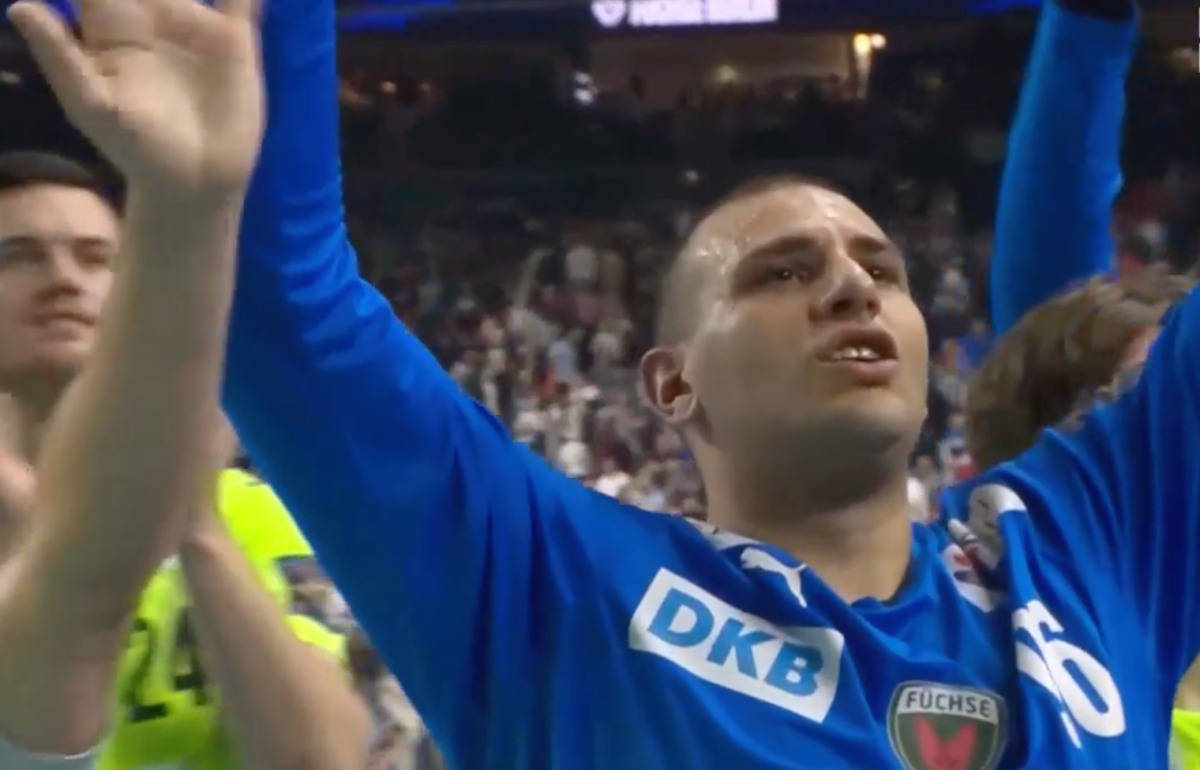
Translated to the court: when the calendar tightens, it is not that everyone trains and competes more. It is that a few absorb almost all the wear while others barely touch it. The authors found season differences of up to 11,100 ACCLOAD units between starters and substitutes at back, and of 6,700 sRPE units between starters and substitutes at wing. Put another way: there are players in the same dressing room accumulating the equivalent of 13 more full matches of load than their teammates over the season.
This is not a statistical detail. It is the explanation for why some players reach March broken and others arrive fresh without having done a useful pre-season since October. Overload in some and underload in others are two sides of the same planning failure, and both generate risk: the first through accumulated fatigue, the second because a player who doesn't reach a minimum exposure threshold loses physical tolerance and arrives poorly prepared when they finally get to play.
Why group training plans fall short
The usual practice at most clubs, including mid-to-high-level ones in Spain, is still to programme load by team: the same series of sprints, the same gym volume, the same number of reps for everyone. The German study shows that this approach ignores what really determines risk: individual variability, not the group average.
The authors themselves propose a practical, replicable threshold that needs no expensive technology: watch for when the team's coefficient of variation exceeds 20% in a week. If that happens, intervene with compensatory sessions for underloaded players, prioritising high-intensity multidirectional work that reproduces the specific match demands they didn't experience. You don't need state-of-the-art GPS to apply the idea: a notebook with minutes played and session RPE per player already lets you calculate that dispersion by hand.
"There are players in the same dressing room accumulating the equivalent of 13 more full matches of load than their teammates over the season."
The study's limitation is honest and must be stated: it is a single team, half a season, with no control group on a normal calendar for direct comparison, and no performance data confirming that this variability translates into more injuries or worse performance. It is a piece of solid evidence, not a closed truth. But it fits what any conditioning coach with experience of demanding pre-seasons already suspected intuitively.
Artificial intelligence comes into play: the Metz case
In March 2026, Florian Felice, a mathematician at the University of Luxembourg, published in the same journal a fatigue prediction model trained with data from Metz Handball, a French women's Champions League team, during the 2024/2025 season. The system uses LSTM (long short-term memory) neural networks over 1,617 gyroscopic sensor sessions, with layers that learn each player's individual profile and a language model (Phi-4-mini) that turns the numbers into explanations readable by the coaching staff.
The accuracy results are notable: the prediction error for total distance covered improved by 14% over the reference methods, and the 95% confidence intervals were correct in all test cases for acceleration load. The model also confirms, with hard data, something the trained eye already senses: wings accumulate more distance and top speed (5,294 metres and 26.1 km/h on average), backs generate more metabolic power (8,173 W) and pivots move less in volume (3,964 metres) but with a very different effort profile, more contact and less running.
Here we need to be critical. This kind of tool is exactly what elite handball needs to manage the variability the German study describes. But it has an obvious problem of scale: the data are the exclusive property of Metz, the system is tied to sensors from a specific brand (Kinexon) and validation was done in a single team. It is a promising proof of concept, not a solution that will soon reach a Segunda División club or an ASOBAL team on a tight budget. The technological gap between the four or five clubs in Europe that can pay for this and the rest will widen before it narrows.
The underlying problem: matches are added, not resources to manage them
What these two studies expose, read together, is a contradiction handball has been dragging along for years. European competitions have grown in number of matches and travel demands, national-team windows remain untouched and federations keep adding formats without investment in coaching staffs, physiotherapy and load monitoring growing at the same pace. The result is predictable: more matches unevenly spread across squads, with the science available to detect it but without the resources to act on it at most clubs.
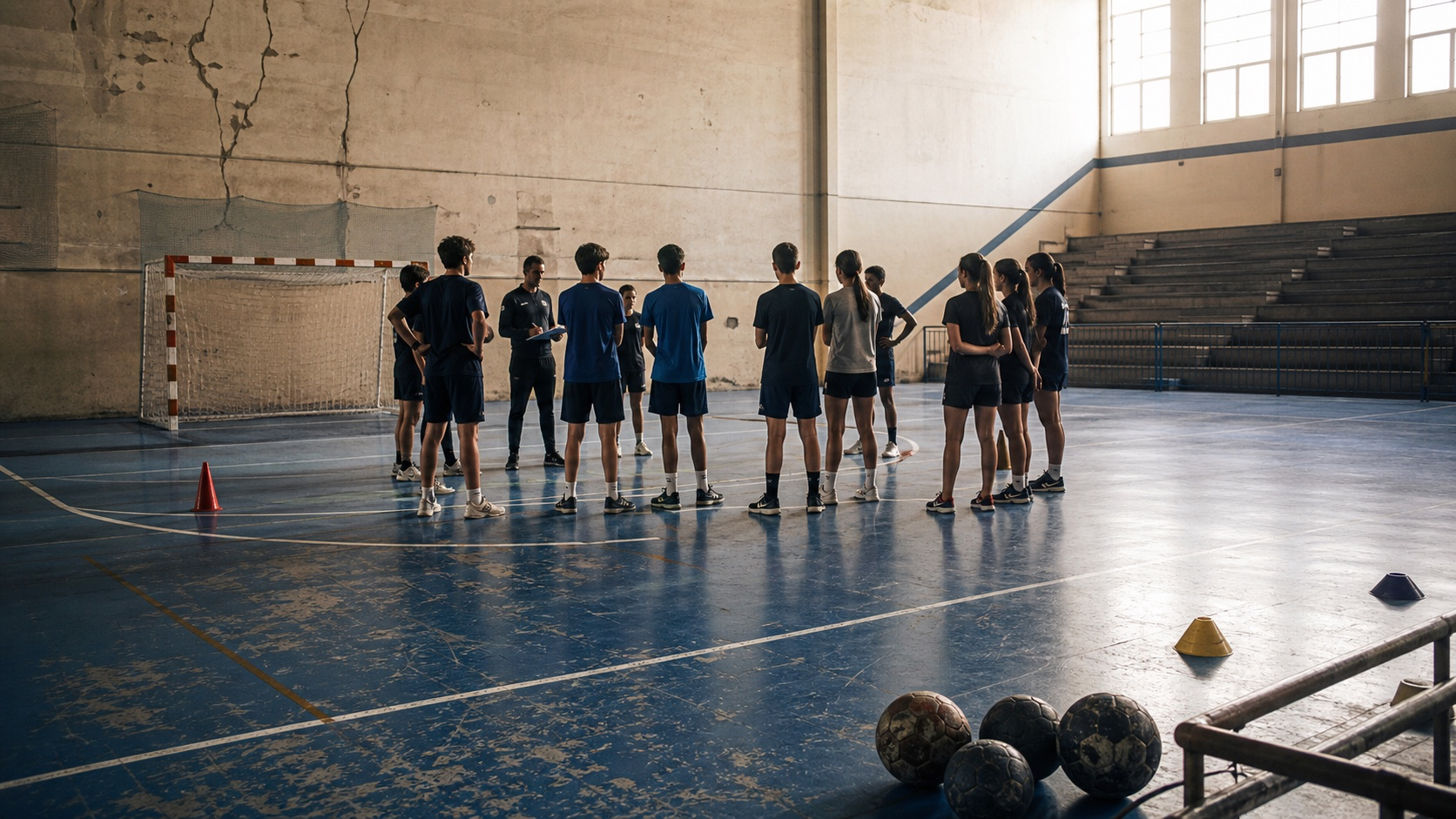
You don't need a doctorate in physiology to understand what comes next. Short-rotation players (the six or seven who always play) accumulate wear that no pre-season compensates for, and those with the fewest minutes lose the physical base needed to perform when they are needed. Both scenarios increase injury risk, and both are documented in the literature on shoulder injury prevention in handball, one of the most active research areas in the sport in recent years, with recent systematic reviews and meta-analyses insisting that generic prevention programmes, without individual adjustment, have limited impact.
What a coach without a Champions League budget can do
The good news is that the applicable part of this science doesn't require state-of-the-art gyms or contracts with sensor suppliers. A mid-to-high-level coach can:
- Record minutes and perceived exertion: minutes played per match and session, and an RPE scale from 0 to 10 after every training session and match. With those two data points, calculate the dispersion between players each week (no advanced statistics needed: it is enough to compare the range between the one who has accumulated the most and the one who has accumulated the least).
- Compensate, not just rest: explicitly identify, every congested week, who has played little and design a short, high-intensity compensatory session for them, instead of simply letting them rest while the rest compete.
- Rotate by accumulated load, not just by performance: a player who has played three consecutive matches of maximum demand needs minutes management even if they are in their best form.
None of this replaces an artificial intelligence model trained on thousands of sessions. But it narrows the gap between what science recommends and what a club without an EHF Champions League budget can afford to apply tomorrow.
Conclusion
The figure that should worry any coaching staff is not how much the team trains on average. It is how far apart the most demanded player and the least demanded player are within the same dressing room, especially when the calendar tightens. Cutting-edge technology, like the Metz model, points to where the sector is going, but today it is within reach of only a handful of clubs. The part that is within everyone's reach is simpler than it seems: keep a basic record of minutes and perceived exertion, and use it to protect both the player who plays too much and the one who plays too little. Ignoring that variability, which is exactly what continues to happen at most squads, is leaving open the crack through which most second-half overload injuries slip in.
