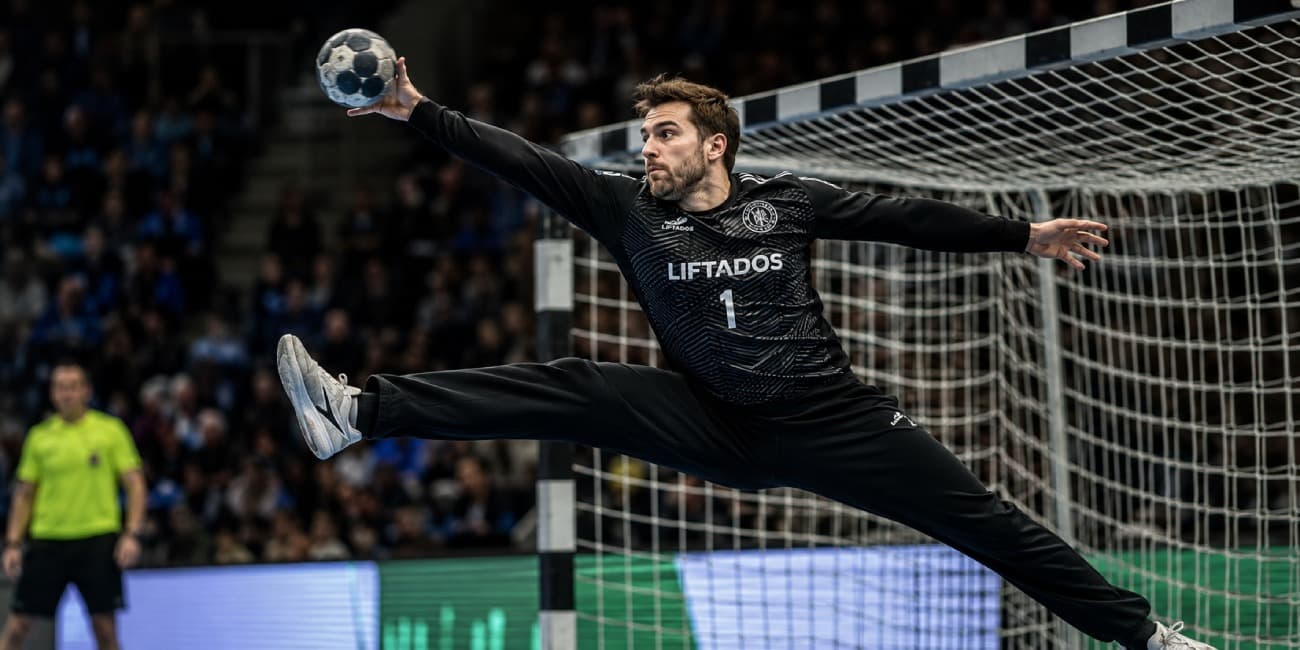
In twenty years of coaching handball, I have seen one constant repeated in every club I have been at and every team I have competed against: the goalkeeper is always the player who receives the least specific training in proportion to his importance in the result of the match.
I think about it and still find it hard to believe. The goalkeeper is the player who can decide a match single-handedly. He is the player who turns goals into saves and opposing attacks into counterattacks of his own. It is the position from which the release of the ball is most directly organised. And yet, in most of the teams I know (and in my own team during my first years as a coach, to be honest) the goalkeeper gets ten minutes of specific warm-up and the rest of the time works on exercises designed for the court players.
This has started to change at the elite level, but in youth categories and amateur handball it is still the norm. This guide is a summary of what I have learned about specific goalkeeper training, the most common mistakes and the five pillars that make the difference between a competent goalkeeper and a goalkeeper who wins matches.
Why the goalkeeper is the hardest position to train
Before going to the pillars, I want to be clear about why this situation exists. The goalkeeper is the hardest position to train in handball for a structural reason: his skills are largely reactive, not proactive. A wing can work on his angled shot by repeating the technical movement with or without a defender. A pivot can practise his movements without the ball, his screening positions, his receiving turns. But a goalkeeper needs shooters to train what matters most: reading the shot.
And the shooters, the court players, have their own things to train. Court players' time is scarce. You can't ask three wings to spend half an hour shooting so the goalkeeper can work on his technique, because those wings have their own training to do. This tension between the goalkeeper's needs and the collective resources available is what makes goalkeeper training always the first thing cut when time has to be adjusted.
The solution is not magic. But there are ways to maximise work with the resources available, and there are pillars that can be trained even without shooters.
Pillar 1: the timing of reading the shooter
The most common mistake young goalkeepers make is trying to react to the ball. It is understandable: the ball is the most obvious reference object. The problem is that an elite handball shot reaches speeds of between 85 and 110 km/h from nine metres. The ball's flight time is approximately 300-370 milliseconds. Average human reaction time to a visual stimulus is 200-250 ms. The difference between the two values is so small that a goalkeeper who waits to see the ball before reacting is permanently at a disadvantage.
The best goalkeepers in the world (Pérez de Vargas, Landin, Klimpke) don't react to the ball. They react to the shooter. They read the pre-shot indicators (the orientation of the shoulder, the angle of the elbow at the start of the movement, the position of the trunk) and make the decision on direction before the ball has left the hand. They are not always right. But when the anticipation mechanism works, the result is what we see on television and it looks like magic.
This mechanism can be trained. It cannot be taught analytically (you can't tell a goalkeeper "when the elbow is at angle X move your right leg") because the speed of conscious processing is not enough. It is trained through repeated exposure and immediate feedback. The goalkeeper shoots, the coach identifies whether the decision was correct before the result, and the goalkeeper reconstructs the process. Over time, the pattern becomes automatic.
To train this without shooters, video analysis of opponents is an underused tool. Spending 20 minutes before a match watching shots from the opposing right wing (his elbow patterns, his tendency to cross or open up) costs no training time. And when that wing appears in the match, the goalkeeper already has information.
Pillar 2: independent segmental coordination
One of the most distinguishing skills of elite goalkeepers is the ability to move the arms and legs independently and in a coordinated way. When a goalkeeper extends the left leg to cover a low zone and simultaneously raises the right arm to cover the far post, he is executing a highly complex multi-joint movement that requires a segmental coordination most court players don't need to develop.
This is a pillar that can be worked on without a ball. There are coordination exercises with poles, ropes or simply on the floor that develop segmental independence effectively. Exercises with coordination ladders adapted to the goalkeeper position also work: lateral footwork combined with arm movements in the opposite direction. They are not spectacular exercises. But they build the coordination base on which specific technique is later built.
Pillar 3: the counterattack outlet as the team's first pass
Modern handball has transformed the goalkeeper's role in transition play. A goalkeeper who makes a save and waits for his teammates to come and get the ball is giving the opposing team a two- or three-second head start. The best current goalkeepers read the position of their teammates while the ball is still in the air, identify the most advanced teammate in a position to receive and make the pass in the same movement as recovering the ball.
This seems simple but requires specific training. The goalkeeper has to learn to read the court while his body is executing the saving movement (which is when all attention tends to be concentrated on the ball) and that is a skill developed through repetition, not through theoretical instruction. In the player rating data of the Liftados ranking, the goalkeepers with the best score in the context factor are precisely those who contribute most actively to transition play.
A simple exercise: after every save in training, the goalkeeper has to say out loud the name of the teammate he would pass the ball to before passing it. It forces him to read the court even in situations where the tendency is not to. Over time, the reading becomes automatic and the goalkeeper starts to see it naturally.
Pillar 4: handling the goal conceded
No goalkeeper stops every shot. The difference between a goalkeeper who saves 35% and one who saves 28% (which is more or less the difference between the elite and the intermediate level in save percentage) in a match with 30 shots is about two goals. Two goals the goalkeeper can hand to the opponent without making any technical error, simply because the shot was good.
What differentiates goalkeepers who stay steady for 60 minutes from those with pronounced ups and downs is not technique. It is the cognitive management of the goal conceded. A goalkeeper who concedes a hard goal and loses concentration during the next two or three attacks is actually giving away another two or three goals he could have saved. The goal conceded is a structural part of the goalkeeper's job. It has to be trained as such.
How? With post-goal protocols. A goalkeeper with a clear protocol (recover position, four-count breathing, a reset word or gesture) returns to the state of optimal alertness in less time than one who handles the goal conceded in an improvised way. This protocol is worked on in training by deliberately including goal situations: not only in matches or scrimmages, but also in exercises where the goalkeeper knows he is going to concede goals and has to manage that information.
Pillar 5: defensive communication as a tactical function
The goalkeeper is the only player who sees the court from behind. That perspective gives him information no other player has: where the opposing pivot is, when the defending back loses sight of the first passer, when there is a penetration threat the line defenders are not seeing. That information, if the goalkeeper communicates it clearly and at the right moment, can change the outcome of an opposing attack.
The problem is that many young goalkeepers concentrate all their energy on the ball itself and don't process the peripheral tactical information. And those who do process it sometimes don't know how to communicate it in a way their defenders can act on. Defensive communication is a tactical skill that has to be trained explicitly, with team-specific terminology that all players understand: "pivot free!", "right back alone!", "step out!" to indicate that the advanced defender must press.
At Trapagaran Eskubaloia we have built a defensive vocabulary that the goalkeeper uses during the match. It is no more than eight or ten terms, but they are consistent and the whole team knows them. The result is more effective communication that allows faster defensive reactions to situations the goalkeeper sees before the defenders. It is pre-season work of two or three sessions that pays dividends throughout the season.
The goalkeeper in the playing system: a necessary change of mentality
The most important change in goalkeeper training is not technical. It is conceptual. We have to stop thinking of the goalkeeper as the player who is there "just in case" the defence fails, and start thinking of him as an active player in the collective playing system who can contribute as much as or more than any court player.
The best teams in the EHF Champions League build their defensive systems with the goalkeeper integrated: the goalkeeper is part of the structure, not the last resort. And their counterattack systems too: the goalkeeper's pass to the first runner is the first link in the offensive chain, as important as the last pass before the goal.
When I started coaching this way, the performance of the goalkeepers I have had improved notably. Not because I taught them new saving techniques, but because I gave them a more complete and demanding role that activated them in a different way. Goalkeepers who know they are important (who understand that their function goes beyond stopping shots) compete differently. And that, in handball, shows on the scoreboard.
