
An elite pivot weighs, on average, 101 kilos. A standard handball shoe is designed, conceived and tested for a very different body. That difference is not a shop-floor detail: it is the reason many big players get injured more and perform worse than their strength should allow.
The figure brands don't mention
When we talk about "handball shoes" in general, marketing tends to imagine a typical body: agile, between 75 and 85 kilos, with quick footwork and explosive changes of direction. That is the profile of a wing or a slim back. But handball is not a one-body sport.
A study of 93 players from the Kosovo Superliga (Havolli et al., 2020) measured body composition by position. The results are clear: pivots weighed on average 101.73 ± 11.13 kilos, against 74.52 ± 8.70 for wings, 86.75 ± 10.83 for backs and 77.75 ± 10.31 for goalkeepers. In other words, an elite pivot weighs, on average, 27 kilos more than a wing. And many amateur-level backs and club players also exceed the 90-kilo mark without being pure pivots (Source: Applied Sciences, MDPI (se abre en otra pestaña)).
That mass is not excess weight: it is the tool of the trade for the position. The pivot needs volume to withstand constant contact with the opposing centre back, to avoid being displaced in the screen and to finish with their back to goal against two defenders. But that same mass multiplies the forces the foot has to absorb on every step, every stop and every jump landing. And that is where most handball footwear fails without anyone saying it out loud.
What happens to a shoe designed for 75 kg when someone weighing 100 wears it
The physics is simple: the greater the body mass, the greater the ground reaction force on each contact. A 100-kilo player generates noticeably higher load peaks than a 75-kilo one in the same braking or turning movement. Research in sports footwear biomechanics has long pointed out that the density and stiffness of the midsole determine how much energy is absorbed and how the joint is aligned on landing, a decisive factor in preventing knee injuries.
The problem is that most single-density midsoles are designed and tested with average-weight profiles. When a heavy player uses that same material, two things happen: the foam compresses all the way down (what in the jargon is called "bottoming out", losing all useful cushioning) and the foot loses lateral stability on changes of direction, because the midfoot support is not calibrated for that load. Recent work on graded-density midsole foams shows that combining zones of different hardness improves the ability to absorb energy without sacrificing rebound, compared with a homogeneous foam (Source: Uddin et al., 2024 (se abre en otra pestaña)). It is the direction brands should be moving in for this player profile, and some already are, although they don't always communicate it that way.
The knee and the ankle pick up the bill
Injury data in elite handball leave little room for ambiguity. A 45-week prospective study of 189 elite male handball players, published in 2025 in BMJ Open Sport & Exercise Medicine, recorded an incidence of 2.2 health problems per player per year, with the knee as the most frequent location for both acute and overuse injuries. Acute injuries, moreover, generated more than four times the burden (days lost) of overuse injuries (Source: PMC (se abre en otra pestaña)).
The anterior cruciate ligament is the injury that worries every coaching staff most. The "ACL registry in German Sports", with data from seven consecutive seasons in the German men's first and second divisions and published in 2025 in the Journal of Experimental Orthopaedics, recorded 84 ACL injuries, with a higher incidence in the first division than in the second and almost half of the cases (46.3%) being re-ruptures. The risk increases with match exposure and with a history of previous knee injury (Source: PMC (se abre en otra pestaña)).
On top of this comes the ankle sprain, the most common injury in the day-to-day life of any court. A biomechanical analysis published in 2024 in Sports Biomechanics documented, with kinematic data from a real case, how the foot goes into forced inversion just at the instant the maximum braking load is applied during a handball-specific cutting movement, a pattern that repeats constantly in pivot play and in defensive screens (Source: Sports Biomechanics (se abre en otra pestaña)).
None of these studies says footwear is the only cause. Landing technique, eccentric ankle and knee strength, accumulated fatigue and the competition calendar itself weigh as much or more. But footwear is the only variable the player directly controls at every training session, and for someone over 90 kilos, the difference between a midsole that holds up and one that sinks shows match after match.
What to really look for if you weigh more than 90 kilos
Midfoot stability, not just cushioning
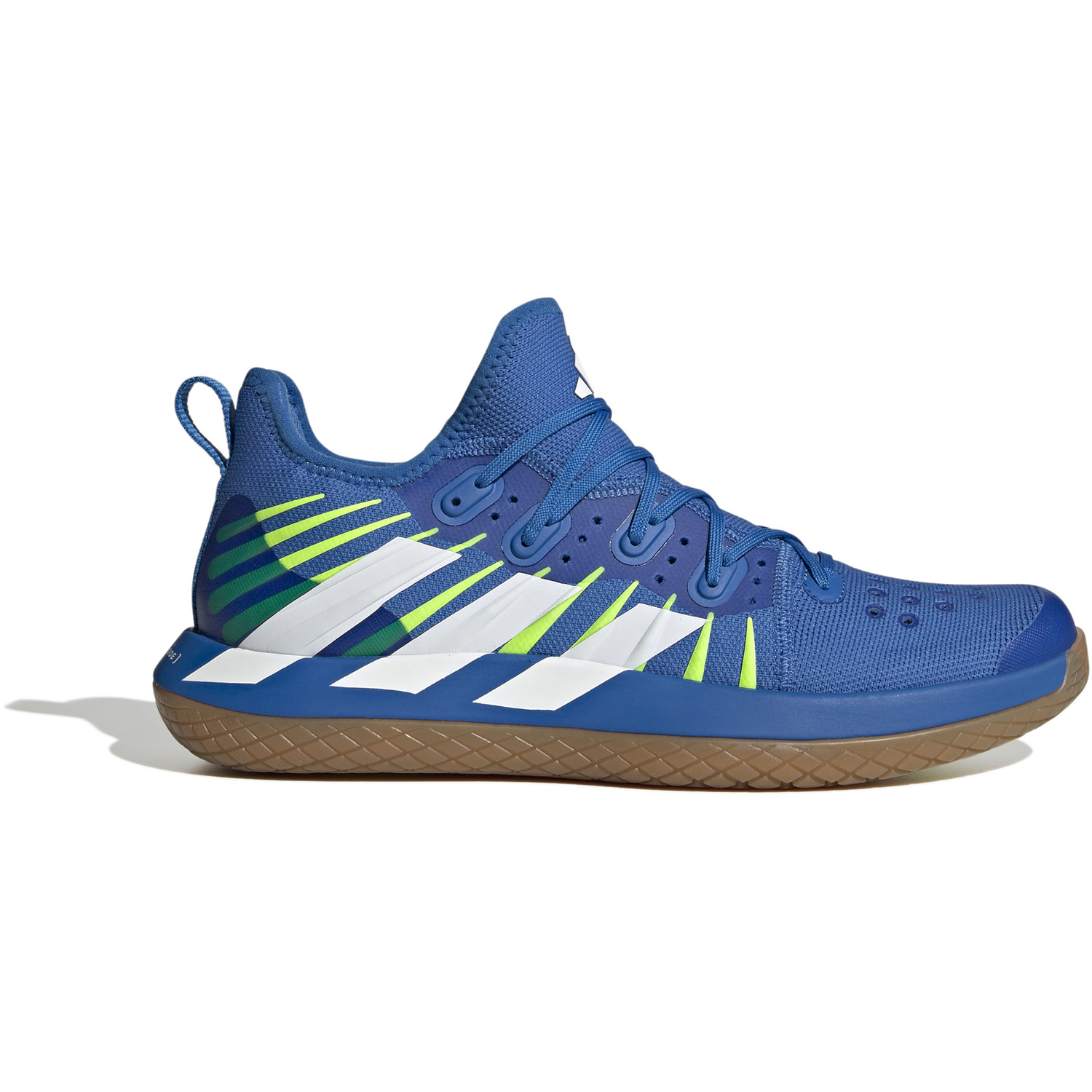
The first thing to demand is not a soft foam that "feels good" in the shop, but a system that stops the foot collapsing inwards on the plant. Adidas Stabil Next Gen has reinforced this idea with an internal cage system (Inner Sling-Cage) that stabilises the midfoot and connects to the lacing, explicitly designed for big players who play pivot or centre back and take constant shoves from the sides. It is one of the few offerings on the market that openly acknowledges this player profile in its own product discourse (Adidas and Liftados explicitly recommend it for anyone over 90 kg), and you can feel it in the sense of lateral lock.