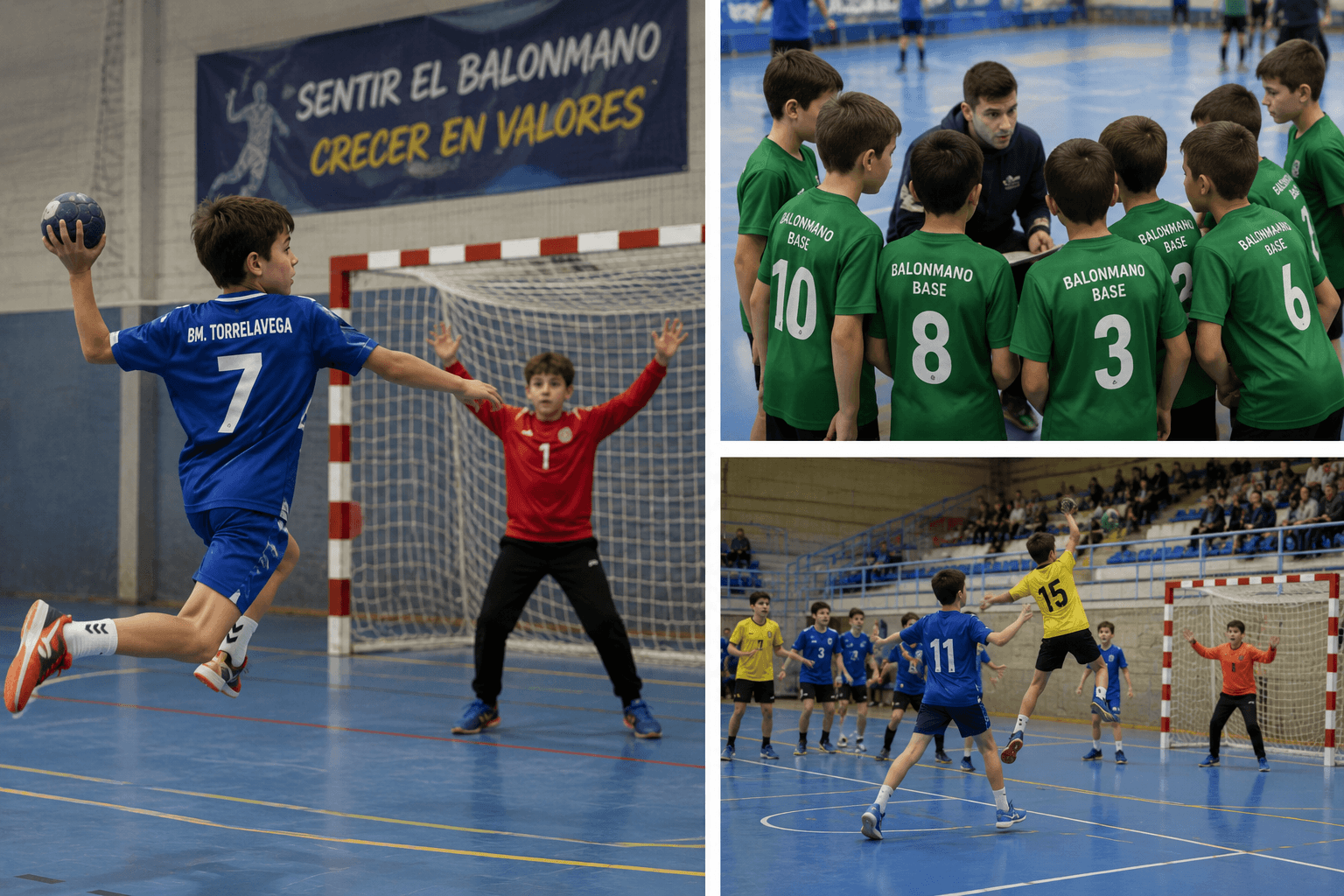

I have spent half my life telling the story of sport from the newsroom and the other half living it from the court: as a Primera División Nacional player at Trapagaran, as a youth coach in Muskiz and, today, as head coach of the Euskadi Infantil Women's selection. From that double journey —that of the journalist who asks and that of the coach who corrects— a method has emerged. And its foundation fits in one sentence that sounds like heresy: in handball, thinking is bad.
1. The foundation of the method: deciding without thinking
If I had to reduce my whole methodology to a single idea, it would be this: everything is based on decision-making work. But with a nuance that throws off anyone hearing it for the first time: I don't want players who think. I want players who make decisions without thinking, and make the right ones.
Thinking in handball is bad. The game goes too fast: when a player stops to reason about what to do, the window has already closed. The defender has already shifted, the gap no longer exists, the pivot is no longer alone. The player who thinks arrives late; the one who has trained reading interprets the situation and the right decision comes to her on its own. That is not magic intuition: it is training. Thousands of repetitions of real situations with forks in the road, until seeing and deciding are the same gesture.
And there is a second floor, which is where the method becomes collective: it is not enough that you decide well. Your teammate has to adopt the right decision in relation to your decision. Handball is a chain: if the back decides to attack the gap, the pivot must decide her screen accordingly; if the centre back decides to fix, the wing must decide her trajectory accordingly. A correct, isolated decision is worth nothing. That is why my drills never train a single decision: they train chains of decisions, yours and the response of the person playing with you.
2. A DNA before a system: defend and run
When I wrote the game model for the Euskadi technical development camp in Zarautz, the first page didn't have a single drill. It had an identity: we want to be a rock-solid team in defence and vertical in attack. Defend and run. It is the axis of everything.
In under-14s, before a system, you need an idea the players can embrace. Ours is this: every ball we steal is an opportunity to run; every goalkeeper's throw-out must be a chance to run. We don't defend to hold on: we defend with the intensity and ambition to steal and break. Direct counterattack, second wave or quick restart —the fast centre throw to attack before the defence exists—, but run whenever possible.
That DNA organises everything else. When a twelve-year-old girl understands what she is defending for, defence stops being the boring toll between two attacks and becomes the start of her favourite play.
3. Clarity is the method
There are many youth coaches who work enormously hard and still feel they could coach better. They lack neither passion nor will. They lack something more concrete: clarity.
My first rule is almost a confession: if a drill needs three minutes of explanation, it doesn't need a better explanation; it needs fewer rules. That is why my sessions are built in ten-minute blocks that start fast, and why I correct with another non-negotiable rule: one priority per drill, not seven. An under-14 player cannot attend to eight instructions at once. I choose one, chase it all session and leave the rest for another day.
The question I prepare every training session with is never "what drill do I do today?". It is another one: "what do I want my players to decide better today?".
4. The advantage is seen before the dribble
If I had to choose the scene that repeats most in youth handball, it is this: a player receives with a small advantage and, before looking, has already dribbled. At that instant, very often, the advantage disappears.
The problem is not the dribble: it is using it out of inertia. When an under-14 team really improves in attack, it is almost never because it starts playing faster; it is because it starts to see better. That is why my attacking drills are seeded with conditions that force players to look: the first reception allows no dribble; a single dribble per player; receiving on the run; no asking for the ball standing still. And in Euskadi's attacking model we wrote it as a team rule: we don't want static players, a lot of ball movement and little holding, real fixing —genuinely drawing a defender in before releasing— and continuity as a habit.
When the drill works you notice straight away: unnecessary dribbling drops and the speed of passing and decision rises.
5. Defence educates too
In youth development there is a great deal of talk about attack and defence gets dismissed with a "get in position and hold on". I argue the opposite: defending is one of the most powerful ways to learn to read the game.
With Euskadi we work on three systems —6:0, 5:1 and 4:2—, but the word "system" is misleading: what we train are behaviours. Always steer towards the outside. Discourage the pass so the attacker receives far away and where she doesn't want to. Force the opponent to shoot from the wing or from beyond nine metres. Defend actively, with legs, creating doubt and provoking turnovers. And a golden rule for balance: defend the centre "without overbraking", which is what I call on court the art of stopping without giving away the other side.
The systems themselves are taught as readings, not as snapshots: if our 6:0 looks for an odd-man situation and doesn't get there, we become a momentary 5:1; if the 4:2 suffers an invasion, it becomes a 5:1. Well-trained youth defence is an exercise in continuous understanding. And it always ends the same way: the outside defenders don't wait for the rebound —they break into the counterattack as soon as they sense the shot—, because defending and running are the same play.
6. The duel is the classroom: from 1x1 to 6x6
The heart of my sessions is the duel with context. But careful: a 1x1 in single file, with fifteen girls watching, doesn't train anybody.
My formula has three ingredients. The whole court, always: I divide the court into zones —usually three— and everyone works in all of them at once; practice density is non-negotiable in under-14s. Defined starts: from standing on a mark, or from half court on the run, because each start teaches a different problem. And progression in layers: 1x1 with advanced defenders who steer to the outside; 2x2 where help already appears (with the "fireman" variant: a third defender at six metres, the only one allowed to commit a foul); 3x2 and 4x3 to play with numerical superiority and inferiority; and from there to 6x6 with the system of the day. The structure grows, but the behaviours —steer, discourage, fix, continue— are always the same.
In my method the "fight it out" 1x1 doesn't exist: the deciding 1x1 does.
7. Rules teach more than talks
This is the part of the method that most surprises anyone who comes to watch a session: I talk little and set a lot of conditions. Provocation rules are silent teachers working every second of the game:
- "No goal counts if you receive beyond twelve metres." There is no need to explain defensive help: the rule forces it to arrive.
- "A foul is only allowed inside nine metres, and only if necessary." That's the end of defending by swatting: legs, orientation and positioning appear.
- "If you are touched while holding the ball, you lose possession" or "you cannot continue the action". Ball protection and play without holding train themselves.
- "Three-second rule" on every goal and every restart: the quick restart is not a poster on the board, it is a timed habit.
- "The goal only counts if there was a visible fixing beforehand." The difference between circulating the ball and fixing is learned by the game, not by the sermon.
Even the consequences are play: if the attacker beats you on the zone you were meant to close, three jumps; if the attack scores after playing with the pivot, two burpees for the defence. Nobody takes offence, everyone competes and the information gets through. And notice the detail: none of these rules tells the player which decision to make. All of them force her to decide better, more often and faster.
8. Numbered decisions, not drawn plays
In my training notebooks there is something you don't see in many youth notebooks: counterattack and positional attack actions don't end in an arrow, they end in a label that says "decision 1", "decision 2", "decision 3". I draw the scenario —the back's long run, the pivot's slide, the centre back's switch— and at each fork the player chooses: shoot, give continuity or play the two-on-two, depending on what her defender does. And the next label is no longer for her: it is for her teammate, who must respond to what the first has just decided.
This goes all the way down to the goal: in the goalkeepers' warm-up, each shooter freely chooses her trajectory and, depending on it, the short or long angle. Free decision-making, there too. And it is backed by video: Euskadi's game model has a linked playlist with each situation —superiority, inferiority, invasions against 5:1 or 3:3— so the players see what they will later have to decide.
The goal of the TARE puts it bluntly: strengthen game reading and decision-making in real situations. In under-14s we don't train executors of plays: we train players who choose well without realising they are choosing.
9. Before shooting, learn to run
The method has a physical leg that starts long before the ball, from a very young age, and begins with the most basic thing there is: teaching how to run. Running is the skill most used in a handball match and the one least taught. In my teams, running technique is key: in pre-season we work with running coaches, who correct footstrike, arm swing, cadence and posture as they have been doing with athletes for decades.
On top of that we add constant work on coordination and explosiveness: ladders, jumps, changes of direction, rhythms. I believe a great deal in what other sports have been perfecting for decades —athletics teaching how to run, weightlifting teaching how to push, gymnastics teaching how to control the body— and part of my job as a coach is to look outside handball and ask how to apply it to our sport.
Strength, in under-14s, is written with the same care: no external loads. Strength with the player's own body —lunges, push-ups, glute bridge with core, one-arm rows, isometrics— with slow, controlled execution, moderate effort (RPE 7) and generous rests. Jumps in small doses. And endurance by playing with rhythms, from one to ten, so they learn to listen to their own effort. Good progression is never adding more cones or more kilos: it is raising the demand —cognitive or physical— without losing clarity.
10. Let the session end up resembling the game
Every drill in my notebook has to pass a final exam: does this look like handball? That is why my sessions almost always end in real play —a 3x3, a 6x6 with the system of the day, a conditioned match— where decisions have to survive the disorder of the real game. If they only work in the drill, they weren't decisions: they were choreography.
And from that comes my definition of success, which is also the last key of the method: a good session is not the one that ends with the players exhausted. It is the one that ends with the players deciding better without realising it.
A sample session from my notebook
TARE Euskadi Infantil Women's — Transitions · 10-minute blocks
- Selection warm-up (10') — a routine of their own that the players learn and repeat, with running technique and coordination work.
- Game: three passes and run to score (10') — receive on the run, no asking for the ball, three-second rule on every goal and restart.
- Goalkeepers separately (10') — shooting with free choice of trajectory and angle. Goalkeeper is a position, not a punishment.
- Quick restart 4:4 full court (10') — fast centre throw and first decision: fix in width or change trajectory.
- Counterattack with numbered decisions (10' + 10' in 6:6) — long run, pivot slide, centre back switch: decision 1, 2 and 3, each responding to the previous one.
- Defence and attack against 5:1 in 6x6 (20') — active advanced defender who blocks passing lanes, outside defenders who discourage, and a break into the counterattack as soon as the shot is sensed.
This method draws on the EHF's development materials (Circle of a Handball Life), on the IHF's games-based approach (Handball at School) and on the technical development materials of Basque handball. The complete game model of the Euskadi Infantil Women's Selection was worked on at the TARE camp in Zarautz.
