
Every season, Adidas, Puma, Hummel or Asics launch a new shoe promising "less stress on the knee" or "maximum joint protection". It sounds good in the brochure. The problem is that almost none of those claims has a handball-specific biomechanical study behind it. And while brands sell foam, the real scientific evidence points elsewhere: neuromuscular training.
This matters right now because in December 2024 the Journal of Experimental Orthopaedics published the most complete analysis to date of anterior cruciate ligament (ACL) injuries in professional men's handball: seven seasons of the German ACL registry, with 5,320 players from the first and second Bundesliga. The numbers leave no room for ambiguity and should change how a club invests its prevention budget.
What the numbers say
The study, signed by Resch, Krutsch, Szymski and their team at the FIFA Medical Center of Excellence in Regensburg, recorded 84 ACL tears between the 2016-17 and 2022-23 seasons. The overall incidence was 0.044 injuries per 1,000 hours of exposure (training plus matches), but with a brutal difference between categories: 0.064/1,000h in the first division versus 0.031/1,000h in the second (p<0.001). In other words, playing at the highest level doubles the risk.
The figure that should worry any coaching staff most is this: the 46.3% of those injuries were re-ruptures. Almost half of the players who tore their cruciate had already been through the operating theatre before. The general literature puts the risk of a second tear above 17% in the first five years after the initial injury, and this registry confirms it in practice.
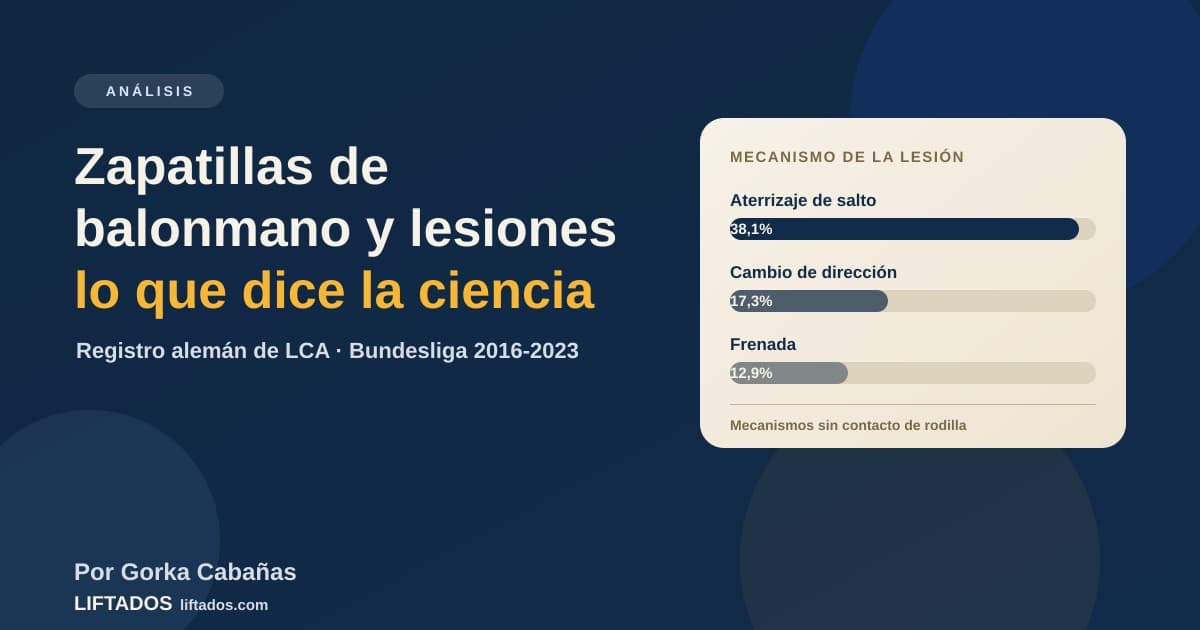
How do these injuries happen? Here is the key to understanding why footwear, although it matters, is not the magic solution the adverts sell. The 38.1% occurred during the landing from a jump, the 17.3% in a change of direction and the 12.9% when braking. These are non-contact mechanisms, linked to neuromuscular deficits and landing technique, not to a one-off failure of the outsole.
Handball is the second professional sport with the most injuries in Germany after football, with an average of 1.9 injuries per player per season.
For context: a systematic review cited in the study puts the general incidence at 7.8 injuries per 1,000 hours in senior men, 6.2 in senior women and 6.9 in youth categories. The International Olympic Committee classifies it among the Olympic sports with the highest injury rate. This is not an anecdote, it is structural to the sport.
Footwear does matter, but not the way it's sold
Let it be clear: equipment matters. Several studies on ankle injuries in elite handball, with up to 18.1% of injuries located at that joint, point to inadequate footwear as one of the associated risk factors, along with previous injuries. An outsole that doesn't control lateral movement, a fit that allows internal sliding of the foot or a midsole without adequate torsional rigidity in the pivoting zone do increase exposure to sprains.
The important nuance is something else: most of the brands' commercial communication doesn't talk about the ankle, which is where there is some biomechanical support, but about the knee and the ACL, where specific evidence on handball footwear practically doesn't exist. Puma advertises its IGNITE foam as responsible for "less stress on knees and ankles". Adidas attributes greater explosiveness in jumps and sprints to its Boost technology. Hummel promotes its double EVA layer for its impact absorption. These are product marketing claims, not conclusions from controlled clinical trials on handball players. Searching the recent literature, I have found no independent study published in the last twelve months that measures a real reduction in ACL incidence attributable to a specific shoe model. If one exists, the brands are not citing it in their own spec sheets, which says a lot.
This doesn't mean the foam is useless. Cushioning reduces the accumulated impact load in repeated landings, and that can ease joint discomfort in the medium term. But equating "more cushioning" with "fewer ACL tears" is a leap that no serious handball study has yet validated. It is well-constructed advertising, based on generic biomechanics from running or basketball, transferred to handball without more ado.
What has been shown to reduce injuries
While footwear remains in the realm of promise, neuromuscular prevention programmes have hard data in their favour. The study by Achenbach and his team, published in Knee Surgery, Sports Traumatology, Arthroscopy in 2018 and cited as a reference in the 2024 German registry, showed in a prospective controlled trial that balance, strength, agility and landing-technique exercises reduce serious knee injuries in young handball players. What matters: that programme requires no special equipment. Nothing to buy in a shop. Just training discipline and technical education on how to land and how to change direction without loading the knee in valgus.
The 2024 German registry itself insists in the same direction when identifying the real risk factors: previous injury to the same knee (present in 33.3% of cases), and short-term competitive load peaks ( 25% of injured players had played more matches than usual just before, and 20% had played three matches in the seven days before the injury). That is the real ground for prevention: load management and neuromuscular work, not replacing the shoe every six months.
What a player should buy, then
There is no need to throw the footwear catalogue in the bin, but the buying criteria should change. Prioritise torsional fit in the forefoot area and a well-reinforced ankle collar, which is where the epidemiological evidence does support a protective effect against sprains. Be wary of any specific claim about "knee protection" or "ACL prevention" that isn't accompanied by a reference to a published, peer-reviewed study, because today that reference, in handball, doesn't exist.
And if the real goal is to lower the risk of cruciate rupture, the investment with evidence behind it is not in the next 140-euro shoe, but in fifteen minutes of structured neuromuscular work before every training session and in watching the accumulation of matches in tight calendars. The clubs that understand it this way, and not those that spend most on footwear sponsorship, are the ones that will save themselves the re-ruptures that today account for almost half of all ACL injuries recorded in the top German competition.
An honest checklist before buying
So as not to stop at criticism, here are four criteria that do have backing, ordered by what each really contributes according to the available evidence on ankle injuries and foot support in handball.
- The ankle collar. A mid or high cut, with good padding at the malleoli, limits the range of sudden inversion of the foot in changes of direction, the movement that produces the most sprains.
- The base of the outsole in the forefoot area, where there must be enough directional grip without being "stuck" to the floor, because excess friction transfers the torsion directly to the knee instead of allowing a minimal controlled slide.
- The real fit of the foot within the last. A wide shoe on a narrow foot, or the other way round, generates internal micro-movements that no foam compensates for.
- The real useful life of the outsole, the most ignored criterion. A handball shoe loses a good part of its grip and cushioning between 200 and 300 hours of intensive use, long before it is visible to the naked eye, and continuing to compete with a worn outsole cancels any advantage the model promised from the factory.
None of these four points is highlighted in the big brands' campaigns for the 2026 season. They talk about foams with proper names and collaborations with EHF Champions League players, but rarely about last, wear or torsional fit, which is exactly where epidemiology does find a relationship with real injury risk.
