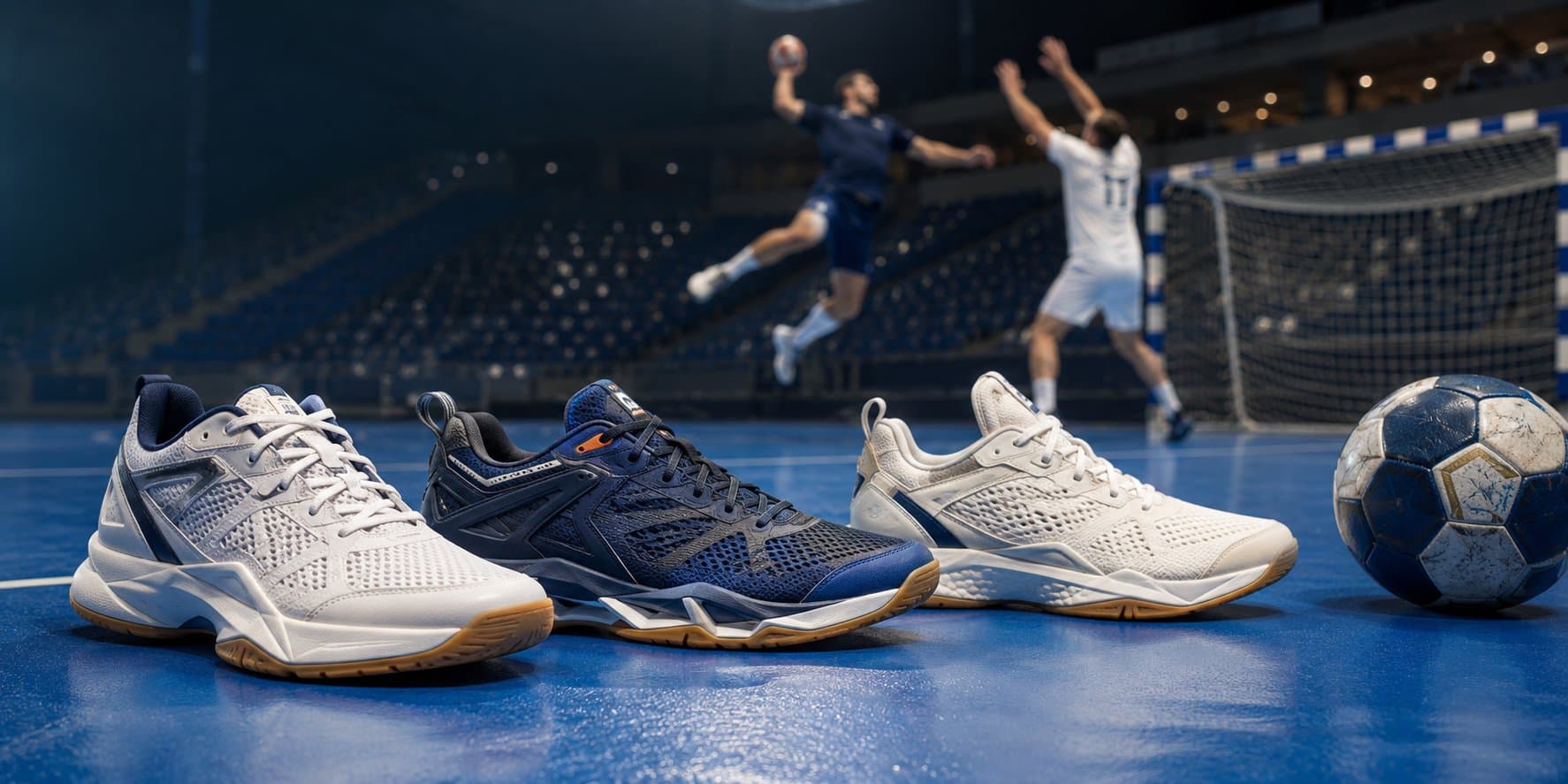

Handball shoes: traction is not enough
Analysis
All features
17 July 20268 min read

Handball shoes: traction is not enough

A biomechanical study published in Sports Biomechanics shows for the first time, with real data, that the shoe-court interface is a key factor in the ankle sprain mechanism. The market keeps selling grip without solving the problem.

This article contains affiliate links; if you buy through them, Liftados may earn a commission at no extra cost to you.

One ankle sprain every nine matches. That is, broadly, the bill elite handball pays for a gesture as everyday as a change of direction. A biomechanical study published in November 2025 in Sports Biomechanics has just put numbers and frames to what many coaches have suspected for years: the shoe not only protects, it can also be at the origin of the injury. And the market for specialist footwear, with launches such as the new Adidas Novaflight 2, keeps selling speed and grip without fully solving that problem.

The ankle, the link that always gives way

The numbers have been saying the same thing for a decade. The reference study in Spain, published in Apunts Sports Medicine on 496 players from a southern European club over five seasons, recorded 557 injuries in 117,723 hours of exposure. The ankle accounted for 18.1% of all of them, ahead of the knee (15.3%), the thigh (12.9%) and the lower back (10.6%). Among ligament injuries, ankle sprains represented 51.3% of the total, with an average of 9.2 days of absence per episode.

This is neither an isolated nor an old finding. A recent systematic review on basketball, handball and volleyball —sports with similar cutting and braking patterns— again places lower-limb injuries as the most prevalent in the group. The pattern repeats season after season because the gesture that causes it (fake-and-cut, sudden braking, change of footing) is structural to the game. You cannot train to eliminate it. You can only try to protect the point of support better.

Anatomy of a handball shoe: load points on the ankle
The points of greatest load on the ankle during a change of direction. The critical instant lies between 190 and 200 ms after initial ground contact.

What the 2025 biomechanical study reveals

This is where the work of Bagehorn, Bill, Mai, Krosshaug and Kersting (Aalborg University, German Sport University Cologne and the Oslo Sports Trauma Research Center) contributes something that was scarce: kinematic and kinetic data from a real sprain, not a simulated one, recorded during a handball-specific cutting movement in a female player.

The researchers compared the injury trial with six earlier attempts by the same athlete. The plantarflexion, inversion and internal rotation angles of the injured ankle were substantially greater than in the reference attempts, with the peak between 190 and 200 milliseconds after initial ground contact. The inversion and internal rotation moment spiked. But the finding that matters most to whoever designs or chooses a shoe is another: the traction coefficient at initial contact, together with the ankle and hip position and the stride length, pointed to a "preparatory mismatch" before the foot touched the ground.

"It was not an excess of grip that caused the sprain, but a combination of a poorly prepared footing and a shoe-surface interaction that did not cushion the error."

Translated: the authors themselves conclude that the shoe-court interface must be considered "an important factor" in the injury mechanism. It is the first time this has been documented with biomechanical data from a real accidental sprain in handball, not in a laboratory with controlled protocols.

This connects with a discussion that already exists in sports footwear design: traction is not a variable to be simply maximised. Too much grip at the wrong moment of the footing prevents the foot from sliding slightly to dissipate rotational force, and that rigidity is what ends up loading the anterior talofibular ligament. Devices such as Spraino, a low-friction system developed specifically for indoor court sports, start from this same logic: reducing traction at the critical instant of the lateral footing reduces the incidence of sprains, according to trials published in Foot and Ankle Surgery.

What the market offers in 2026

The current range of handball shoes has not ignored the problem, but neither has it put it at the centre. The best-rated models this year compete mainly on three axes: weight, lateral stability and reactive cushioning. The commercial discourse revolves around explosiveness and energy return, not around the intelligent management of traction on compromised footings.

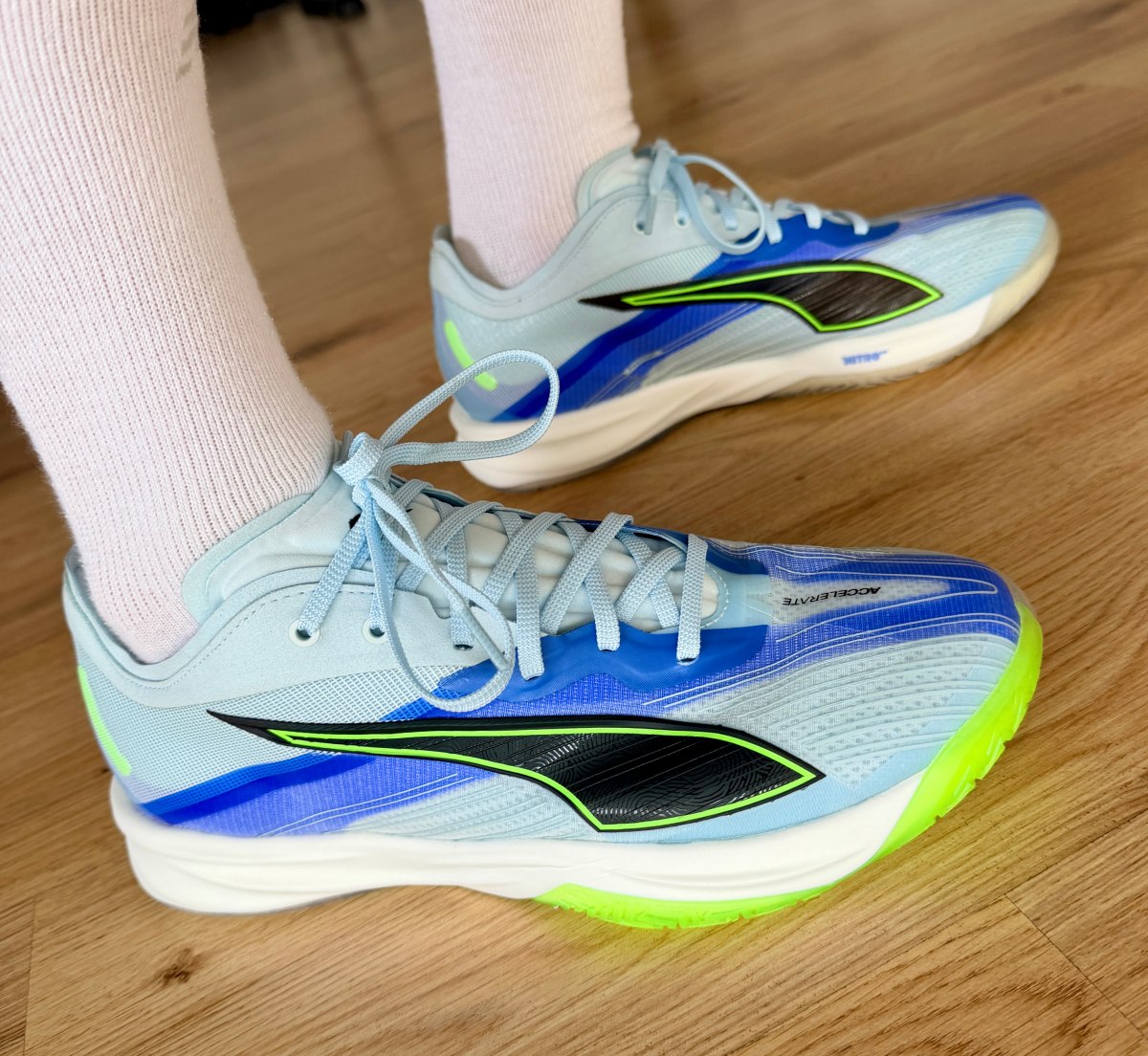
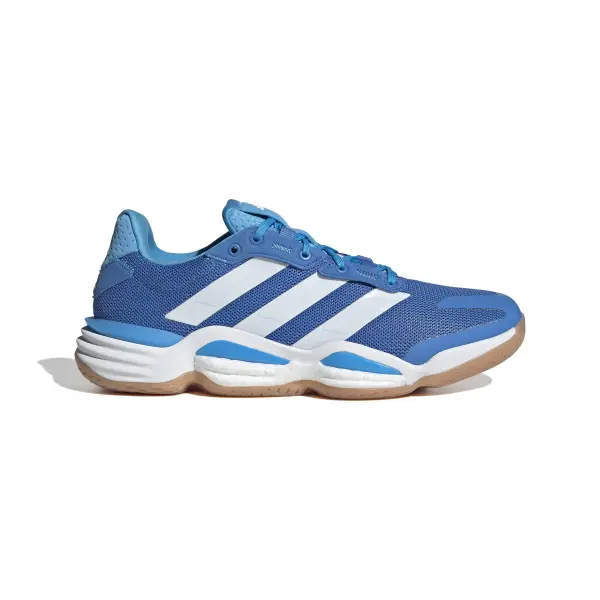
At the top of the ranking are the Puma Accelerate Nitro SQD 5 —the best handball shoe for wings and backs according to our analysis— and the Adidas Stabil 16, the benchmark for pivots and centre backs who need maximum lateral stability. Both dominate the 2026 technical comparisons.
-8%
Puma Accelerate Nitro SQD 5

Puma

Accelerate Nitro SQD 5

€144.00

From

€131.90

Lowest price found at WePlay Handball · 2 stores compared

Next come the Mizuno Wave Stealth Neo 2, with one of the most highly rated GUM8 grips on the market, and the Asics Sky Elite FF 4 for attacking profiles. None of them includes dynamic traction coefficient data in its spec sheet.

-22%
Adidas Stabil 16

Adidas

Stabil 16

€144.00

From

€111.90

Lowest price found at WePlay Handball · 3 stores compared

Handball shoe outsole comparison — traction pattern
Current outsole patterns prioritise uniform adhesion. No brand spec sheet includes dynamic traction coefficient data measured in real conditions.

The most recent launch that illustrates this priority is the Adidas Novaflight 2. Designed for intermediate-to-advanced wings and backs, it weighs 280 grams, mounts an indoor HC (hard court) outsole and reactive Lightstrike EVA foam, and is positioned as a cheaper alternative (110 euros) to the flagship Stabil 16. It is a legitimate development in performance terms. But no brand spec sheet shows a measured traction coefficient figure, or an explanation of how the outsole pattern behaves in the millisecond range where the sprain occurs.

This is no coincidence: measuring dynamic traction in real game conditions is expensive and methodologically complex, and it doesn't sell as much as a video of a wing finishing at an empty goal. The global indoor handball footwear market, valued at around 500 million dollars in 2025 and with a projected annual growth of 6% to 2033, has more than enough incentive to invest in that research. For now, it is not doing so with the transparency the problem deserves.

The outsole is not marketing, it is prevention

Here is the underlying flaw. Brands talk about "superior grip" and "stability in changes of direction" as generic claims, but the 2025 biomechanical study shows that the problem is not the amount of grip, but its behaviour at a very specific instant of the footing. A rubber compound that grips a lot in normal conditions may be exactly the one that prevents that protective slide when the foot reaches the ground poorly prepared.

Grip test on handball shoes — traction coefficient
The traction coefficient at the instant of footing, not in static conditions, is the data missing from every spec sheet on the market.

The practical consequence for anyone buying handball shoes for wings, centre backs or pivots today: look at the outsole pattern and the hardness of the compound (durometer), not just at weight or cushioning marketing. Models with a high, uniform-adhesion HC outsole are, according to the logic that emerges from this study, the ones that concentrate the most risk in emergency footings.

The Mizuno Wave Stealth Neo 2 and the Adidas Crazyflight 7 are two opposite examples on this spectrum: the first prioritises maximum GUM8 grip; the second sacrifices some traction in favour of lightness. Neither documents the behaviour of its outsole at the critical instant of the footing.

-9%
Mizuno Wave Stealth Neo 2

Mizuno

Wave Stealth Neo 2

€113.62

From

€103.69

Lowest price found at Forum Sport · 2 stores compared

Adidas Crazyflight 7

Adidas

Crazyflight 7

Out of stock right now

Combining good footwear with proprioceptive ankle work —the other pillar of prevention that the literature has consistently supported for years— remains the most reasonable strategy until the industry offers independently verified dynamic traction data.

What players and clubs should do

There is no miracle handball shoe that eliminates the risk of sprains: the study itself insists that the "preparatory mismatch" before contact is as decisive as the footwear. But there is real room for improvement on two fronts.

First, demand measured traction data from brands, not just marketing claims. Second, don't separate the choice of footwear from prevention work: no model, however good its outsole compound, replaces the proprioceptive and eccentric ankle strength training that the evidence has shown for more than a decade reduces the incidence of sprains. The shoe is one piece of the prevention system, not the complete solution.

If you are looking for the best option for your position, see our complete ranking of handball shoes 2026 or use the Liftados recommender to find the model that best suits you.

Liftados AI · Recommender

Need handball shoes?

We help you find the model that suits you best based on your position, level and budget. In 2 minutes.

Find my shoes

Frequently asked questions

Which handball shoe protects the ankle best?▾
No shoe eliminates the risk of a sprain on its own. According to the biomechanical study published in Sports Biomechanics in 2025, the 'preparatory mismatch' before ground contact is as decisive as the footwear. Models with a good heel counter and a medium-hardness outsole offer the best compromise between grip and the ability to dissipate rotational forces. Proprioceptive ankle work is essential in any case.
Why can shoes with more traction be more dangerous?▾
Too much grip at the critical moment of the footing prevents the foot from sliding slightly to dissipate rotational force. That rigidity is what ends up loading the anterior talofibular ligament. The study by Bagehorn et al. (2025) documents this mechanism with real kinematic data from a handball sprain.
What is the preparatory mismatch in an ankle sprain?▾
The 'preparatory mismatch' is a combination of factors —ankle position, hip position and stride length— that are not correctly prepared in the instant before the foot contacts the ground. When that mismatch coincides with a shoe-court interaction that does not dissipate rotational force well, the sprain occurs even if the movement is technically correct.
What should I look at when buying handball shoes to avoid injuries?▾
Besides weight and cushioning, look at the outsole pattern (multidirectional is better than uniform), the hardness of the compound (avoid maximum-adhesion HC outsoles if your footing is irregular) and the height of the heel counter. Always combine the choice of footwear with proprioceptive and eccentric ankle strength work.
#handball shoes#ankle sprain#injury prevention#traction#outsole#biomechanics#Sports Biomechanics#elite handball#indoor footwear#adidas novaflight#puma accelerate nitro#adidas stabil 16

About the author

Gorka Cabañas, autor en Liftados
Gorka Cabañas

Sports journalist · Handball coach

Journalist — El Mundo Deportivo · El CorreoFormer player — First Division (Trapagaran Eskubaloia)Head coach — Basque Country Infantil Women (U14)

Journalist at El Mundo Deportivo and El Correo. Former player in the Spanish First National Division (Trapagaran Eskubaloia). Youth coach at Balonmano Muskiz and head coach of the Basque Country Infantil Women's team (U14). Co-founder of Liftados.

Club Liftados

Plus, just for signing up we give you the guide with 10 training tasks for youth handball coaches.

You join Club Liftados and get a practical resource right away to coach with more clarity, improve your reading of the game and work better on the court.

Instant PDF for coaches
Practical ideas for the court
Analysis and educational content every week
Shoe deals with judgement