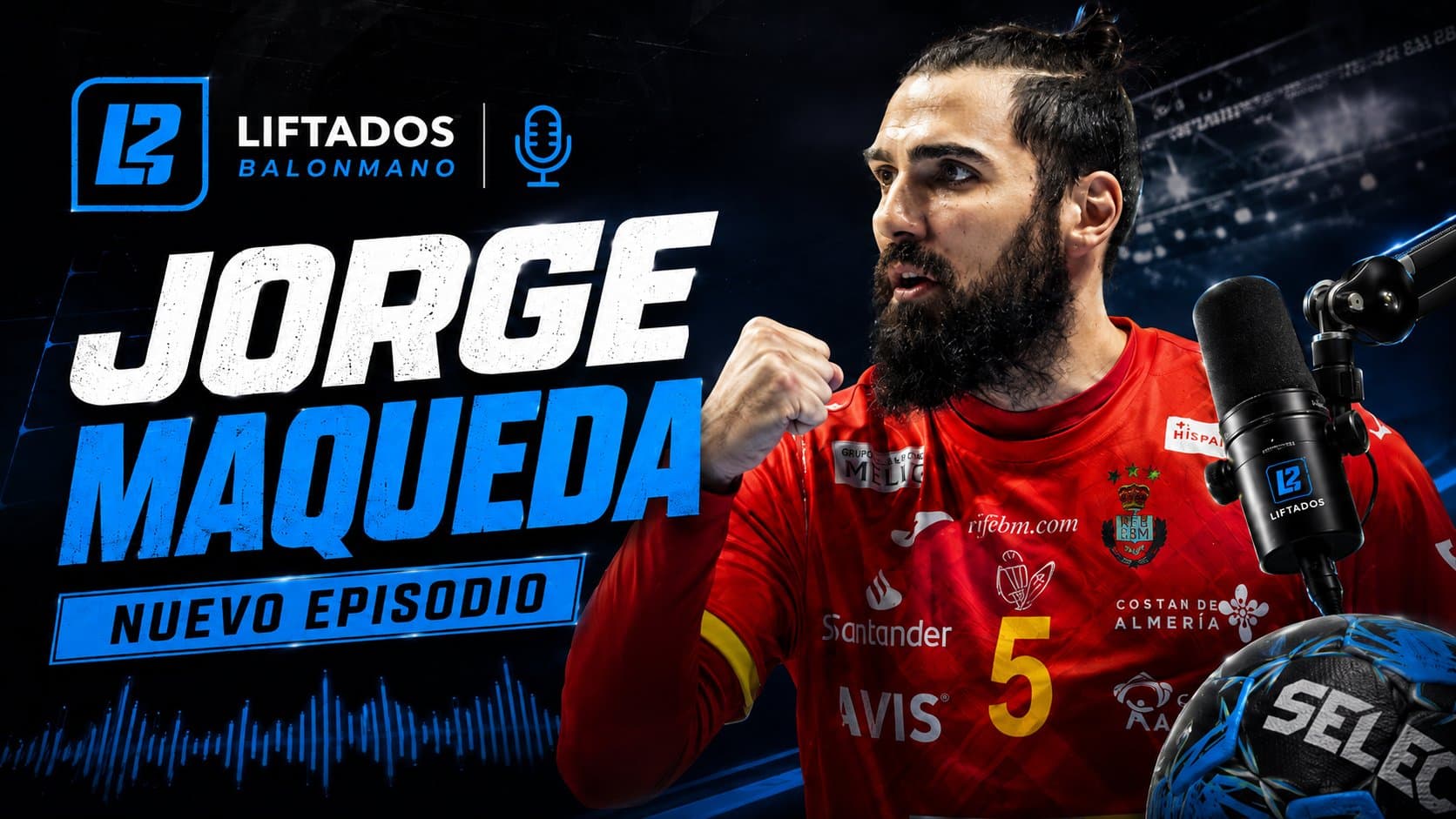

Jorge Maqueda walked into the ball room in Villafranca because his uncle Jesús couldn't take any more. "Head over to the sports hall, there's surely someone playing something there, go there and stop bothering me." That is, literally, how the story of one of the most complete backs Spanish handball has produced begins. Courtesy of a relative's exasperation.
This week we welcomed him to Liftados. We recorded it in a ball room —yes, with balls on the shelves and a bottle of Arehucas behind us that had been there since the women's team played in Plata in the Canary Islands— and it made for an hour with the KS Kielce back that is worth listening to in full.
Uncle Jesús and the Villafranca sports hall
Maqueda's origin story is so good it's annoying we hadn't told it before. As a kid he was, in his own words, "a real handful". One summer at his uncle Jesús's house, at the end of his tether, he came out with the line that changed his life: "Head over to the sports hall." He went. They were playing handball. He asked if he could play. The coach saw what he had in front of him: tall for his age, big and left-handed. The conclusion was immediate: "I'm not going to put you in to play football, you're a clumsy oaf, so stay here with us." All of Spanish handball owes something to uncle Jesús.
From Villafranca to Valero Rivera's camp at 15. A coach there had contacts in Barcelona through his brother, they pulled on them, and Maqueda ended up at the trial. At the end, Valero met with him and his parents: if they wanted, he would stay in the Blaugrana youth setup. Not in La Masía, which was then almost exclusively for football, but in a flat with a tutor. That's how things were done.
2017: European champions in Skopje
If there is one moment in Maqueda's career that deserves a paragraph of its own, it is the 2017 Champions League with Vardar of Macedonia. They won. And when they went back to Skopje, what awaited them was beyond description: from the airport to the city centre, everyone on the motorway, all the cars stopped. They on the obligatory open-top bus. The square packed. National heroes.
"I've never experienced anything like it in my life", says Maqueda. And he says it as someone who has won medals with the Spanish national team, who has played at Veszprém and at Kielce, where the hall fills up for every Champions League match. But that was different. The Vardar fans, as he describes them, are football-style, ultras-style: "You arrived there and your eardrums hurt from the noise." That team, with Raúl González and Davis on the bench, wasn't the favourite. We already know what happened.
Raúl González: the one who taught him to see handball
We asked him which coach he has learned most from. Without hesitation: Raúl González. "I used to play very rough, very animal, inward, everything inward. Thanks to Raúl, he was the one who taught me to see handball." All his life sending the attacker toward the weak side, outward. He gets to Vardar and they tell him no, you have to send them inward. A new world.
"Thanks to that change I made, I'm playing right now. If I had gone on playing the way I played, knocks, injuries, I wouldn't be playing." That is what a good coach does: not only make you better today, but make it possible for you to keep being so ten years from now. Before Raúl: Rafa Guijosa at Alcobendas, who shaped his character by being hard on him and always pushing forward. After: Talant Dujshebaev at Kielce, who at the slightest thing has a vein in his neck that already has a history of its own.
Sterbik was a cheat code. Karabatić, guaranteed war
The hardest goalkeeper he has faced doesn't take him a second to name: Sterbik. "He was a cheat code, straight up. He was a cheat-code goalkeeper." Not only for what he saved, but for how he intimidated. You saw him and already thought it wasn't going in. He arrived injured at the European Championship in Croatia, they called him in an emergency, and the opponent saw him warming up and their faces changed. That's Arpad.
And the toughest opponent in defence: Nikola Karabatić. Not so much for the violence of the clash, but for the nobility of the confrontation. "A noble guy who goes inward and you can hit him all you want and he doesn't say a word." Clean war, guaranteed war, match after match, with PSG, with the French national team, always the same. In the Jordan game we play on the podcast, Karabatić won every round without anyone being able to dethrone him.
The Spanish national team: friends, not teammates
On the Spanish golden generation, Maqueda puts into words what many of us suspected from outside: they weren't teammates, they were friends. "Everyone wanted to go to the national team camps to be with those people you didn't see often." And you could see it on court: in not minding if you didn't score the goal yourself, in that when they got past you in defence you stepped aside and knew the goalkeeper was going to save it.
With Rodrigo Corrales at Veszprém they had a tacit agreement: "When they break through on two of you, don't even touch it. I'll save it. Don't touch it, because if you touch it they'll whistle the penalty and you'll mess me up." That is trust. That is team. And the last ball always went to Alex Dujshebaev, because when Alex is on form, let whoever can stop it do so.
An hour with one of the greats. Listen to it.
